


Georgia Tech’s School of Applied Physiology moved into its digs in the Engineering Center building in March 2011, but they’re already having to make some adjustments to the space—and it’s a good problem to have.
This fall, the master of science in prosthetics and orthotics program will welcome a class of 14, the largest in its history. (Last year’s class topped out at 10.) They’ll join professor Chris Hovorka, MSPO program co-director and coordinator of orthotics, and his team in researching, developing and manufacturing state-of-the art prostheses (artificial limbs) and orthoses (external braces).
Hovorka and his team gave the Alumni Magazine a closer look inside their sprawling workspace, where they work closely with real patients to focus in on the relationship between human and wearable technology.
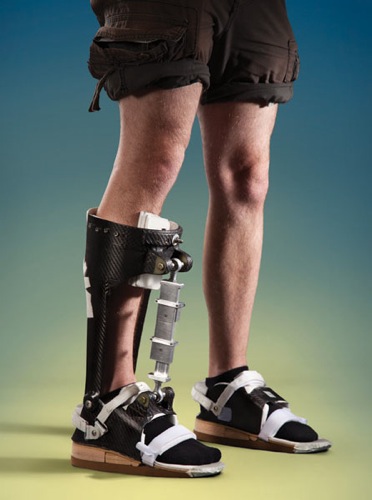
A visiting student models lower-limb orthoses developed in the P&O lab. Hovorka’s team can make custom-fit orthoses and are working with carbon fiber to develop super-light alternatives to plastic and foam devices. The brace on the right leg is a prototype of a system that could replace the bulky, easily-worn-out walking cast that anyone who’s suffered an injured foot knows all too well.
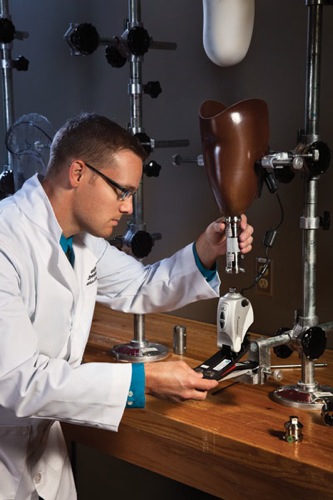
Lab supervisor Scott French fine-tunes an endoskeletal prosthesis. The P&O lab is expansive—parts of it resemble a tidy garage workshop mashed up with a sculptor’s studio.
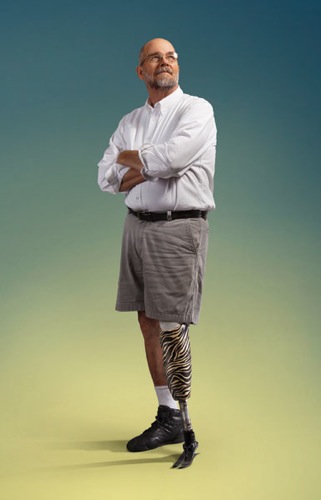
Gary Pline, whose left leg from the knee down was removed in an elective amputation after a motorcycle accident, has served the program as a patient model for clinical treatments and research for eight years. “Gary plays a vital role to help us understand how a person interacts with the various technologies as he performs a variety of motor tasks,” like walking, jogging and sitting, Hovorka says. Pline’s prostheses—one each for the shower, mowing the lawn and driving—are all zebra-print. “It goes with everything,” he explains.



 Twitter