


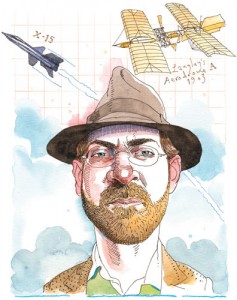
 When I started at Georgia Tech I never thought I would end up working with words for a living. I liked math and thinking in straight lines, and I was fascinated by machines, especially planes. Surely, such a one as this becomes an aerospace engineer!
But early at Tech I received indication that this was not to be. On my first day, a professor asked about my studies. As though quoting prophecy, I told him I was to study aerospace engineering. In response, he asked me why.
Nothing about liking math or thinking linearly bubbled to the surface of my mind. Instead, I found myself saying, “I think airplanes are beautiful.”
“You might want to think about finding another career,” the professor replied.
For years I didn’t get what he meant. I studied aerospace engineering anyway. But I’d now like to commend him.
Aerospace engineering is focused on the efficiency, performance, affordability and ease of manufacture of the final product. This seems obvious now. But when I was young I was fascinated by the slim, sharp edges of the SR-71. I was drawn to its weird, rugged construction of the space shuttle. The diminutive wings of the X-15 compelled my curiosity. I fell for the grand gliders of Otto Lilienthal and Samuel Langley, so birdlike I at first didn’t believe they had been built.
Instead of seeing purpose behind the designs, I imagined these craft to be the output of a distinct sensibility, a peculiar maker closer to an artist than any practicality-reckoning engineer.
At Tech, I was nudged toward the study of poetry by professor Thomas Lux. After graduate school, I began teaching English and apprenticing with Unicorn Press, a small-press publisher of poetry. Now, when I describe my background, people seem to want me to verify that it’s possible to bridge the cosmic divide between the straight-laced work of the engineer and the ethereal efforts of poets.
I’m not going to go there. Or, rather, I have already gone there and discovered my mistake.
Still, my interest in machines has only deepened with the study of poetry. In the valve train of my antique sedan’s diesel engine, I observe something like the order of a sonnet, holding compressed within it the promise of motion. In 2010, browsing the National Air and Space Museum’s Udvar-Hazy Center, I happened upon a reconstruction of Langley’s Aerodrome A suspended from the ceiling I stopped in silence to admire its stately grace—utterly impractical stately grace, since every full-scale aerodrome launched by Langley failed without qualification. Nonetheless, it spread over me like a cymbal crash.
Even now, when I see an airplane pass overhead, it’s something like an idea to wonder at, a stay against the confusion arrayed below.



 Twitter