


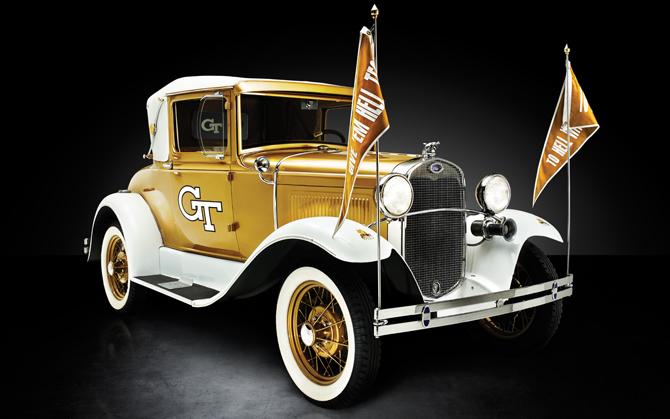
The crime-fighting car Kitt and the starship Enterprise don’t have much in common. But both served as mechanical mascots for TV shows and took on personalities of their own: Kitt’s snarky Britishisms, the Enterprise’s near-endless technological tool-chest of solutions. And at a single glance, each vehicle conjures the purpose and meaning of its fictional universe. Out here in the real world, that’s exactly what the Ramblin’ Wreck does for Georgia Tech.
A 1930 Ford Model A Sport Coupe, the Wreck has been with the school since 1961. Purchased by Dean James Dull for $1,000 (about $15,000 in today’s dollars) the Wreck represents Tech’s technical prowess and dedication to tradition. Needless to say, having a chance to get up close and personal with the Wreck, much less ride along in it before Tech’s football win over Duke, was a rare treat.
It all started with an email to Stephen Webber, a fourth-year business major and member of the Ramblin’ Reck Club. As this year’s Wreck driver, he is responsible for the car’s care and feeding. We met on campus the day before the game to chat about the Wreck, and then I watched Webber and his fellow club members wash and clean it in preparation for its performance the following day.
The Wreck is only driven about 500 miles a year, but keeping a 1930 Model A fully operational is no easy feat. The Wreck was designed before computerized ignition, fuel injection and advanced materials, and so maintaining it often proves a learning experience.
Webber says the Wreck likes to be exercised at least a few times a week, and it runs best once the engine is warmed up.
Unlike modern cars, the Wreck uses no computer controls or automatic engine monitoring. Aside from the traditional accelerator pedal, brake pedal and steering wheel, the other controls are a slaved hand throttle, manual ignition advance lever, choke control, gas adjusting valve and, of course, the horn.
Mechanically speaking, it’s a simple vehicle. Providing locomotive energy to the body-on-frame chassis is a water-cooled, 3.3-liter inline-four, side-valve engine that, on the best of days, could produce 40 hp. (A modern 1.6-liter engine, meanwhile, produces about 140 hp.)
Mated to the engine is a 3-speed manual transmission. Without the aid of synchronizers, the gears grind going into first. Once up to speed though, it’s easier to match the speeds with the revs and make the shifts buttery smooth.
Feeding the cast-iron block and head is a tiny up-draft carburetor, its intake manifold mounted on the same side of the engine as the exhaust manifold. In a nod to usability, its distributer and points-based ignition system offers adjustable ignition advance via a steering wheel mounted lever. Undoubtedly, this—just like the fuel mixture valve, which adjusts the ratio of fuel-to-air dispensed into the carburetor; and the manually actuated choke, which reduces the amount of air through the carburetor thereby richening the fuel mixture—were primarily meant to ease engine start and warm-up.
Although seemingly complicated, the car starts and runs smoothly and downright purrs when it’s warmed up.
Considering it’s about 82 years old, the Wreck is surprisingly stock. Modifications include a modern alternator in place of the original generator, a new horn and a decorative radiator cap that also indicates engine coolant temperature. Otherwise, all modifications are cosmetic, like additional step plates that allow multiple cheerleaders to stand on the reinforced running boards when the Wreck escorts the Georgia Tech football team into the stadium.
Primping before the game is easy, especially when club members help. The spoked wheels and whitewall tires demand special attention, though, as does the white vinyl interior and non-retractable soft-top. Then there’s the endless array of chrome parts that requires elbow grease to make game-ready.
In order to maintain the car, Wreck drivers have to ensure a consistent flow of money to keep the budget healthy. Spark plugs, 600-weight gear oil, 10W-30 engine oil and cleaning supplies don’t come cheap. The Wreck earns its keep by making appearances at weddings and special events.
The Wreck driver must be detail-oriented. During the football off-season, the new Wreck driver apprentices with his predecessor; drivers pass down intimate knowledge: all the intricacies of the start process, how-to information on repairs, proper presentation.
To see the car in action, I rendezvoused with Webber on game day at the end of fraternity row. I spent a couple of hours with him and the Wreck, touring the campus and seeing how the car held sway over the students and alumni.
Driving the car, especially at slower speeds around campus, is an easy affair. The additional engine controls, lack of power-assisted steering and mechanical drum brakes at all four corners are the shining indicators that you’re not in a modern car. The lack of boosted steering necessitates a high-ratio steering box, which means you get an upper-body workout if you make a series of three-point turns. To make even the slightest of turns requires generous steering input. The manual brakes require some sensitivity; they’re mildly grabby. But copious amounts of engine braking ensure you only need to use a dash of brakes.
The suspension system, composed of a beam front axle and solid rear axle, is similar to today’s commercial trucks, but cruder. Underneath the relatively lightweight car (about 2,300 pounds) the suspension is stiffly sprung and undamped. Thankfully, the relatively flexible, unboxed chassis, spoked wheels, and tall and skinny tires (roughly 120/105-19) soften the ride.
The fuel tank is located in between the dash and firewall, so the fuel gauge in the dash is actually just a window into the gas tank. How’s that for crash safety?
Exterior dimensions are familiar: A wheelbase of 103.5 inches and overall length of 152.7 inches makes the car relatively standard sized. For comparison, a 2012 Ford Fiesta 5-door hatchback sits on a wheelbase of 98 inches and an overall length of 160.1 inches.
The Model A is marginally a four-seater. You’d better be OK with personal-space intrusions in the front seats, and let’s not even talk about the rumble seat. Because of the upright seating position, head room is not as good as it could be, and leg room isn’t fantastic either.
As we made our way through campus honking at tailgating fans and stopping to pose for pictures, I was amazed at how smooth the car idled. The mercury level never rose on the radiator cap’s Boyce Motorman temperature gauge, indicating the engine was content to hum along.
As we made our way toward Freshman Hill, the crowd thickened. One club member leaned into the driver’s window, looked at her clipboard and updated Webber on the next mission: a passenger ride-along down the hill and into the stadium.
This time, there would be cheerleaders on the running boards, leading the Yellow Jackets, Buzz and the rest of the cheerleaders onto the field.
After climbing out of the car, I watched the Wreck disappear into the throng, the comfortable chuff-chuffing of its well-maintained engine drowned out by the sound of the band and crowd, students and alumni alike cheering on all that this little 1930 Model A represents.


 Twitter
Great article. Never knew the mechanical details. I wonder, what kind of gas does it use? Does it run on unleaded?