


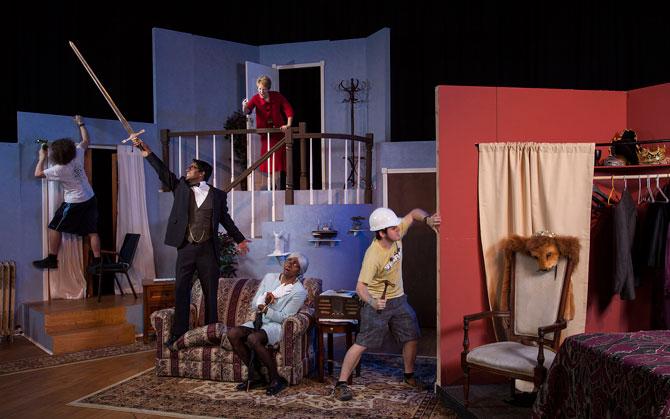
Two weeks from opening night of DramaTech’s mainstage summer show, British-accented accusations fill the Ferst Center’s Dean James E. Dull Black Box Theatre. It’s nothing personal, just the belligerent bon mots of Corpse!, a comedic murder-mystery set in 1930s London.
Tech’s production of the Gerald Moon play costars Tamil Periasamy, AE 07, and Erik Arndt, IE 12, who rehearse a tense scene in T-shirts and jeans. Arndt pulls out a silver-barreled revolver; offstage, an air-filled plastic packaging bag is prepared to provide the critical “pop.”
“Don’t be a fool!” says Periasamy, unarmed.
Half a dozen young men and women, including DramaTech president Tejas Kotak (a fourth-year environmental engineering major) and director Devon Peet (a second-year computational media major), follow the script on laptops and tablets. After a choreographed scuffle, Peet interrupts to remind Arndt, playing the frantic Major Ambrose Powell: “Remember, you need to be aggravated so that your aggravated ulcer makes sense.”
Arndt adds a touch more agony to his line readings. “And what the hell does that mean?” he bellows in character.
“‘And what in God’s name does that mean,’” corrects Kotak.
Set designer Josh Mysona, ChBE 13, seated nearby, looks up from his math homework. “That’s the opposite,” he notes, idly clutching a plastic prop sword.
Three hours into practice, a muted cheer follows the final act. Right now the show lacks polish, but after a set-building party over the weekend, timing and choreography will tighten.
“This is definitely a learning theater,” says Kotak, who joined DramaTech as a freshman. “We allow for a lot of mistakes and experimentation.”
A technical institute with no fine arts program may seem an unlikely place to boast Atlanta’s oldest continuously operating theater company, dating back to 1947, but art director Melissa Foulger says Tech students’ STEM education is a boon for production.
“Scenic, sound and lighting design aligns well with architecture and mathematics. Prop design aligns with industrial design,” she says. However, “engineers sometimes like to over-engineer things. When I started, they sometimes built sets that could be permanent housing structures.”
Earlier this year, Foulger collaborated with Tech PhD candidate and digital media instructor Rebecca Rouse, along with students from one of Rouse’s courses, to stage a DramaTech adaptation of Haruki Murakami’s short-story collection After the Quake that used an Xbox Kinect motion-sensing device to enhance the storytelling.
“DramaTech is much more than a theatre—it’s also a classroom, and it’s also a research lab,” Rouse says. “I hope that in the future, this type of integration of pedagogy, artistic production and research will continue at DramaTech and across campus.”
Alumni maintain a presence in DramaTech, too. Periasamy joined the group as a senior to polish his public speaking skills. Now, six years and 23 productions later, he serves as official DramaTech historian, keeping in touch with alumni from decades past and collecting old programs and promotional articles from the Technique. The two master carpenters for this summer’s production are former students. And last season, alumni directed both the fall show and the spring musical.
Corpse! director Peet may even owe his existence to DramaTech: his parents met in the club during the late 1970s, back when shows were staged in an old church at Hemphill and Ferst. “We had a very low budget when I started,” says his father, Stephen Peet, ME 80. “Freshmen would help straighten out nails at the beginning of the quarter to be able to use them to build the sets.”
Stephanie Daigle, CM 09, heads Friends of DramaTech, an alumni group. Getting involved is as easy as showing up, she says. “Go to the door and ring the doorbell,” she says. “Someone will come and open the door.”
And don’t mind the raucous repartee—it’s all part of the act.



 Twitter