


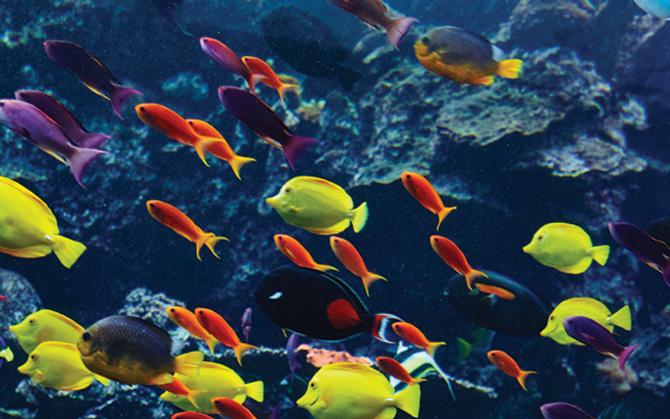
Coral reefs are some of the most diverse and irreplaceable ecosystems on the planet, and at times the woes they face seem too big to fight: climate change, pollution, ocean acidification, overfishing and more. But Georgia Tech’s Mark Hay has spent the past four decades studying how interactions between seaweed, fish and coral shape the success or failure of a reef—and besides illustrating the dynamics of these ecological marvels, his work could show how to save them.
“I started this in the late 1970s, when we had coral reefs in the Caribbean,” Hay says. “Now I would argue we have sort of algal-covered parking lots with a few corals here and there.” Back then, he says, the average Caribbean reef had 50 to 60 percent coverage with live coral. Today, it’s more like 5 percent. “I have two kids in their late 20s,” Hay says. “I can’t show them an average Caribbean reef that existed when they were born.”
Fiji, where Hay does much of his research, has experienced declines, though not as dramatic.
Over-fishing has removed fish that consume seaweed, which then overgrows coral. Some seaweed produces coral-poisoning chemicals, Hay has found. “Think of [the seaweed] as little toxic paintbrushes,” Hay says. But certain reef-dwelling fish love to chow down on seaweed, keeping the toxic plants in check; finding these fish—and protecting them—is the crux of Hay’s research.
In one experiment in the Caribbean, Hay mixed and matched different kinds of reef-dwelling fish and let them loose, finding that out of the 29 fish species, only four types ate macro algae. One kind of fish in particular loved to eat a highly toxic green algae. “It would just start shaking it was so excited. You see them in pair, or sometimes in a group of four, and it just looks like they’re getting ready to rob Baskin Robbins,” Hay says.
In another study, he observed the goby, a small fish that lives its whole life inside one coral. Hay found that as seaweed encroached, the coral would secrete a “chemical 911 call” that told the minuscule multicolored fish to come to the rescue. The goby “act like little hedge trimmers that just trim this toxic algae back enough so it doesn’t touch its coral,” Hay says. “They really defend their home.”
The loss of any of these seaweed-eating species would be especially devastating. Hay’s research has helped pinpoint which creatures are especially crucial to the reef’s overall health, which helps him in working with local leaders to shape fishing regulations and establish marine protected areas. In Fiji, for example, “We wear a [tribal] dress, sit on the floor and drink kava with the chief and tell him what’s going on, and then he and his head men talk about it,” Hay says. “It works really well.”
As a result of these efforts, Fiji’s protected waters range from 40-60 percent coral cover, while nearby areas have only 4 to 19 percent.
“In the areas that had intact food webs, coral recovered,” Hay says. “In the areas that didn’t, corals got traded for seaweeds. It’s clear that, at present, this kind of intervention can have a huge impact.”




 Twitter