


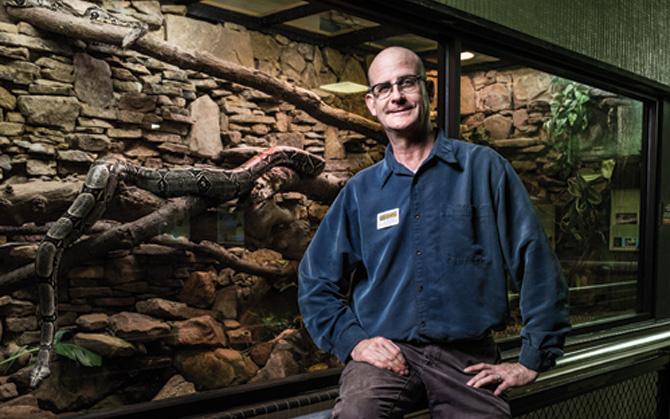
Nine years ago, Joseph Mendelson was settling into life as a freshly tenured professor of biology at Utah State University. But then Zoo Atlanta called and made him an offer he couldn’t refuse: a hybrid research/conservation/teaching position linking the resources of the zoo with the brainpower of Georgia Tech. Now the zoo’s director of herpetological research and adjunct professor in Tech’s School of Biology, Mendelson splits his time between teaching, supervising undergraduate research projects and conducting collaborative research.
He also continues with his own field work—he’s named and identified upward of 35 species of frogs, salamanders and snakes over his three-decade career. Mendelson recently guided the Alumni Magazine around his workspace, which spans across the zoo’s 40-acre campus.
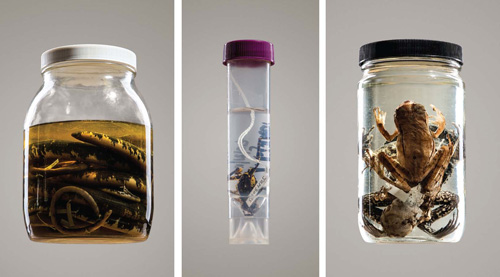
Mendelson’s favorite creatures in the zoo’s reptile and amphibian exhibit are the super-shy Incilius signifer (which he discovered and named) and a 3-foot-long salamander called the Greater Siren. The eel-like creature was thought to be carnivorous until a Zoo Atlanta employee noticed it chowing on plants in its tank; tests confirmed it was omnivorous. “There’s a fundamental piece of the natural history of an animal that is really common all over Georgia that we just didn’t know, except by keeping our eyes open,” Mendelson says. “It’s like being an astronaut every day—‘Ooh, I found something new!’” (Above, he poses with a boa constrictor.)
For Mendelson’s students, the zoo becomes a living laboratory. “In vertebrate anatomy, if we’re looking at muscular-skeletal function, well, we could sit in a room at Tech,” he says. “Or we could go to the zoo and be like, ‘OK, let’s watch the elephant sit. What muscles is it using?’” Members of his independent research class use the zoo facilities to conduct research that informs their senior theses. “Georgia Tech students,” he says, “are getting opportunities that you can’t get at any other school.”
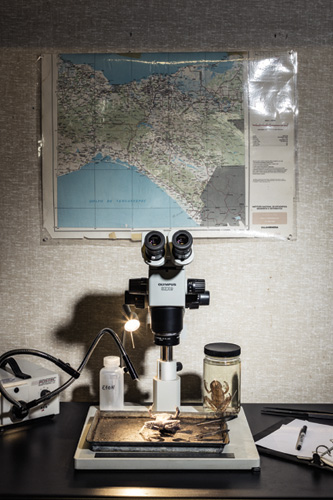
“Sometimes,” Mendelson says, “you find new species by turning over a rock and going, ‘Oh, that’s new!’” Other times, it’s not so easy. In his lab at the zoo, Mendelson spent the fall studying preserved toad specimens (some more than 100 years old) collected from across Nicaragua, unconvinced that they were all the same species. “Sometimes you realize, ‘We thought they were all the same thing, but they’re not.’ That’s a different way to discover a new species. It’s the harder way. It’s not the most exciting way. But that’s what I’m doing.”
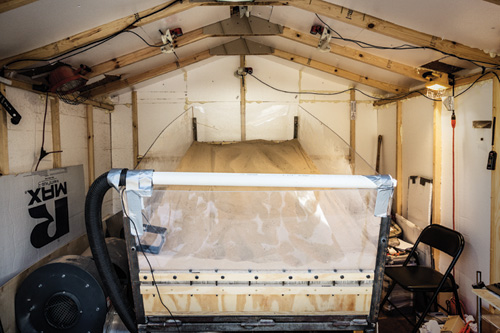
The benefits of Tech’s relationship with Zoo Atlanta extend to fellow faculty. Mendelson has access to creatures prohibited on campus by Tech’s research guidelines—like the venomous sidewinder rattlesnake. This sandbox was home to snake locomotion experiments. (For more on that, see pg. 62.)
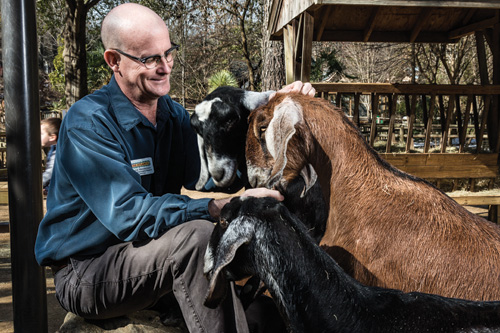
On slow days, Mendelson admits to slipping away from his work to visit the goats at the petting zoo. “I have the key for everything, but I don’t go wandering around in departments that aren’t mine,” he says. “It’s not like, ‘Oh, I’m gonna go play with some pandas now.’”



 Twitter