


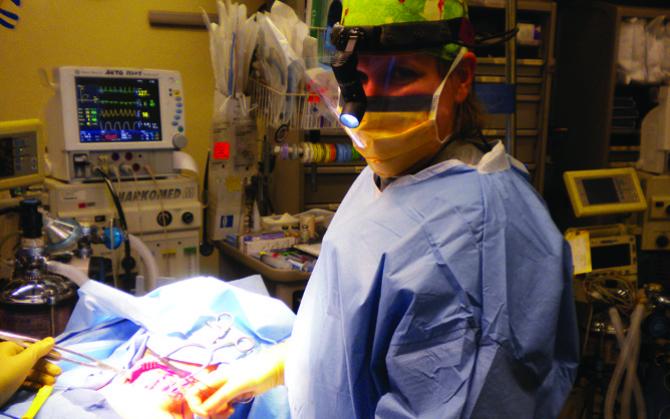
After graduating from Georgia Tech in 1995 with a bachelor’s degree in applied biology, Amy Vertrees struggled to figure out just where she belonged. She applied to medical school during her senior year at Tech but grew cold feet. A brief stint in a PhD program didn’t take. Vertrees wound up working at a mortgage bank and teaching MCAT classes for Kaplan in an obstetrics office before she considered medical school again. She was accepted at the Uniformed Services University and signed on for a 10-year contract with the United States Army. Even then, however, Vertrees didn’t fully understand her purpose as a soon-to-be military surgeon.
Then 9/11 happened. For Vertrees, the attacks inspired a moment of clarity.
“I became more aware that I was in the right place,” Vertrees says. “Before 9/11, I didn’t really understand my role in life. Once we went to war and everyone was engaged, it felt like there was a greater purpose.”
Vertrees earned her doctor of medicine degree from the Uniform Services University in 2004 with a 3.8 GPA. In 2010, she completed her general surgery internship and residency at the Walter Reed Army Medical Center. That year, she was named the hospital’s D’Avis Outstanding Surgical Resident.
Her first combat deployment came the following year, when she spent eight months working in Jalalabad, Afghanistan. Vertrees went into her deployment knowing she would be working at a base with limited personnel and medical equipment. She also knew she would be close to the action.
“The hardest part for me was knowing that I was deploying where no one is 100 percent safe,” Vertrees says. “The first thing I worried about was my safety. But I also worried about whether or not I was going to do a good job. I asked myself, ‘Am I the right person for those wounded soldiers? Are they going to be better off because I was there?’”
On that 2011 deployment, Vertrees worked with a 20-person medical crew and leaned on the support and experience of her team. But in 2013 on her second deployment, this time to Camp Dwyer, Afghanistan, she found herself as the chief medical officer on a staff of just 13.
Vertrees still remembers the worst case she ever encountered in the field. The soldier’s primary wound was a head injury, but there wasn’t a single part of his body that wasn’t injured, Vertrees says. Even worse, the orthopedic surgeon had left early that day. “I rushed him off to surgery because his blood pressure was dropping, and his abdomen was getting larger. He needed immediate stabilization or he was going to die.” The patient was transported to the next level of care where he succumbed to a devastating head injury a few days later.
During urgent situations like these, no matter how horrific, her training quickly takes over. She’s too busy diagnosing a soldier’s injuries and leaping into action to think. It isn’t until later, when the action slows down, that the gravity of the moment sets in.
But Vertrees’s impact extends far beyond the soldiers she served directly in combat zones. Prior to her last deployment, the Army major conducted extensive research on complex abdominal wall closures—a surgical procedure commonly performed in the field on wounded soldiers.
Doctors lacked a good surgical solution that could more effectively close up the abdomen without a high risk of complications or long-term health problems. Vertrees helped pioneer a new technique that uses a mesh implant to serially close large abdominal wounds. Her research gained plenty of attention from her peers and academics, leading to numerous publications about her technique, as well as a few chapters in medical textbooks.
Today, Vertrees works as an attending general surgeon at Walter Reed National Military Medical Center in Bethesda, Md. Her focus—luckily—has turned away from abdominal wall closures.
“Thankfully, the number of military wounded is decreasing,” Vertrees says, “so I’ve had to reinvent myself.”
She’s now involved in better training the next generation of military surgeons, particularly where resident education is concerned. It’s possible that she will be deployed yet again, although nothing has been scheduled.
She’s under contract with the U.S. Army until 2017, but she says she hasn’t thought much about whether she will extend her service or pursue other interests. Says Vertrees: “We’ll see how I feel in 2016.”




 Twitter
How proud we all are of you, dear niece! And, how lucky the Army is to have you.