


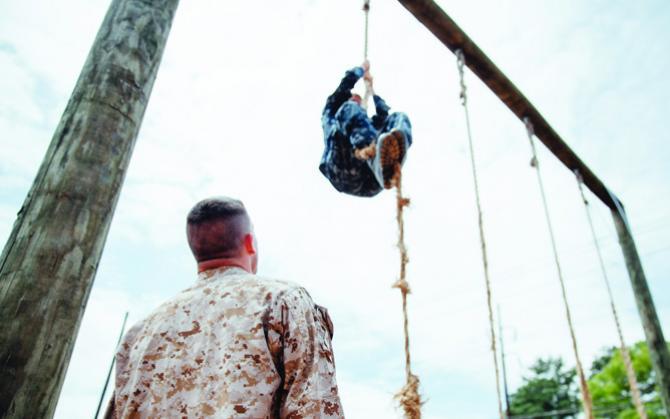
Decades ago, serving in the Reserve Officers Training Corps used to be mandatory for all Georgia Tech students, and the ranks of the campus battalion routinely numbered in the thousands.Today, Tech’s ROTC programs provide advanced training for only an elite few, such as Andrew Townsend and Shelby Downing. Come follow a day in the life of these Marine Corps options.
“I always wanted to be a Marine, ever since I was young,” says Andrew Townsend. The 21-year-old and economics major speaks plainly, just a couple of weeks before commencement. He is within days of achieving his childhood goal. When Townsend graduates, he’ll be commissioned as a second lieutenant in the U.S. Marine Corps. “I didn’t even think I’d go to Georgia Tech,” he continues, his hands in his lap. He grew up in Tucker, 20 minutes away from campus. “But I knew Tech was a good school and had the Naval ROTC. That’s what I wanted to do.”
The plan seems surprisingly simple for a student who has surpassed every benchmark laid out for him since he started in 2010. Townsend not only secured one of the coveted four-year national scholarships in the Reserve Officers Training Corps that would eventually train him to be a junior officer: During his tenure at Tech, Townsend also earned a slew of awards.
He was recognized as the Officer Candidates School Honor Graduate last summer, then named the Navy ROTC’s midshipman of the year by USAA. Last fall, he served as battalion commander, helping train younger students preparing to attend Officer Candidates School. It’s the highest leadership a Marine option can attain.
Townsend’s leadership responsibilities mean that he looks out for his fellow students, including junior Shelby Downing. Her path to Tech’s ROTC Marine program took on a different nature.
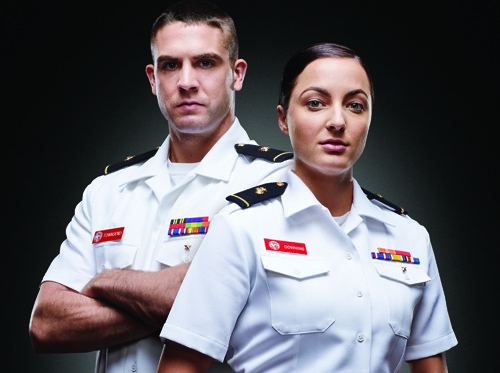
Andrew Townsend and Shelby Downing
“I had so much free time my freshman year,” the 22-year-old recalls, her right knee elevated on a chair. It’s sore and a bit swollen after her unit’s physical training that morning. “I do better when I’m busy.”
At the time, Downing was majoring in nuclear radiological engineering, but still felt stressed by what she calls the “lack of structure” in her life. She got a job as a facilities assistant at the Campus Recreation Center, then took a full-time internship position over the summer to fill up her calendar. It wasn’t enough.
“I was like, is this it?” she says, looking around quizzically for emphasis. Downing’s stepmom joked around with her, suggesting she might as well join the military. “I thought, wait—what if I did?”
Downing is the first in her family to attend a university—so she knew she wanted to stay enrolled and not drop out to enlist. So the Montgomery, Ala., native set her sights on the NROTC Marine Corps program. She introduced herself to the unit’s Marine officer instructor, Capt. Joshua Roberts. Unfortunately for Downing, there were no Marine option scholarships available. Not only that, she didn’t meet the rigorous physical requirements.
“I said, ‘I’m sorry, it’s great that you want to be here but you don’t meet standards,’” Roberts says. “Usually when that happens, you’ll never see that person again. Downing walked out of my office and said she would find a way, that no one was gonna tell her no for an answer.”
Six months passed before she could earn a scholarship as a Navy option student. But even then, she kept her focus. A year would pass before Downing had the opportunity to compete for a Marine Corps slot. When it finally became available, her fitness abilities had improved tenfold, says Capt. Roberts. She earned the scholarship on her first attempt. Downing is scheduled to graduate in spring 2015 with a bachelor’s in business with an IT concentration.
Townsend and Downing are bright representations of what Georgia Tech’s ROTC program looks like today. They are two of 18 students on track to commission as Marine Corps second lieutenants upon completion of their studies at Georgia Tech. Those 18 Marine options round out the 67 students participating in the Georgia Tech NROTC battalion, which includes students from Georgia State and Southern Polytechnic State. They make up just over half of the 124 students who are the Atlanta Region Consortium.
The consortium includes a second battalion that’s based at Morehouse College, which includes students from Spelman College and Clark Atlanta University. The consortium came into effect in 1982, a result of pooled resources as ROTC numbers drew down over the years. But it wasn’t always that way. At its peak enrollment, Tech ROTC units held memberships of thousands of students every year.
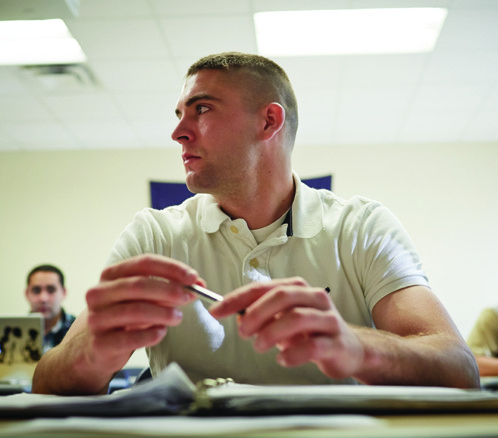
Andrew Townsend excelled in Tech’s Navy ROTC program as a Marine option, eventually becoming battalion commander his senior year. Now that he’s graduated from Tech, his next stop is The Basic School, a rigorous six-month Marine Corps program for newly commissioned officers.
A Brief History of ROTC at Tech
Much has changed in the world since the ROTC was first established at Georgia Tech in 1917, not long after the United States declared war on Germany. In a 1969 military science paper on the history of Tech’s Army ROTC, Major John H. Matthews wrote that the 1917 faculty voted to make ROTC participation obligatory for all physically capable students.
This decision was a precursor to the Student Army Training Corps bill of 1918, which Congress passed under the shadow of the Great War. The bill would allow draft-eligible men to be readied for military service without simultaneously depleting colleges and universities of their student body. Whether or not to keep the ROTC in place after the end of World War I caused considerable discontent on campus. Students protested throughout 1919 to terminate the program, Matthews wrote. The unrest continued until President Kenneth Matheson and faculty elected to continue the ROTC.
In the years following, the program grew—freshmen and sophomore students were required to participate, while juniors and seniors could elect their participation once basic courses were completed successfully. In light of Georgia Tech’s notable track record with the Army ROTC, the Department of the Navy selected Tech as one of six universities to launch the Navy ROTC in 1926. The program received prominent attention—Winston Churchill and President Franklin Roosevelt both visited in the early 1930s. For the first 10 years, NROTC annual membership ranged from 200-270 midshipmen. An expansive naval armory was built in 1935 at the center of campus. The Technique ran images of cadets practicing drill, interviewed midshipmen before their summer cruises, and discussed how the War Department’s latest changes would impact the day-to-day of Tech ROTC students.
And times continued to change. By the early 1960s, Matthews wrote, other considerations impacted the outlook Tech faculty had on ROTC programs. Namely, the unpopular Vietnam War and a shift from a drafted military force to an all-volunteer one. In 1965, the faculty voted to end mandatory ROTC service, which coincided with the implementation of scholarship programs, passed by Congress.
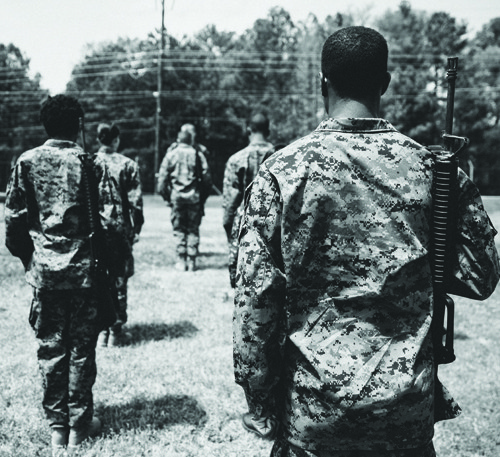
As membership in ROTC decreased, so too, did its ubiquitous presence on campus. In 1980, the naval armory was torn down to make room for the Edge Athletic Center Building. The NROTC moved to the corner of Bobby Dodd Way and Fowler Street, then moved again in 2007 to its current residence on the second floor of the O’Keefe Building, a space it shares with the Army and Air Force ROTC units.
O’Keefe is where Townsend and Downing report to Capt. Roberts and their commanding officer, Capt. Mario Mifsud. It’s where they have their NROTC classes on naval science, leadership and ethics. It’s also the home of a makeshift student center: one well-lit room with a couple of couches and a handful of computers. It’s where midshipmen do homework, discuss upcoming drill assignments, plan events and play foosball. It’s also where the platoon of Marine options meet up before piling in the “govvies,” large passenger vans that take the group up to the obstacle course in Marietta, at the home of the Marine Corps Forces Reserve, 4th Reconnaissance Battalion.
A Day in the Life
Downing is upset, though she’s trying not to show it. Today is “O Course” day, one of three during the semester where the Marine options practice on the Marine Corps Recon obstacle course. They train for this course throughout the semester, trying to save the practice times for the warmest days of the season. Downing will not be able to participate.
“I went to the doctor,” she says, fighting back tears. “Something is going on with my hips.”
That morning, Downing’s doctor explained that the constant pain in her hips was due to the friction of her hip bone and socket rubbing together on each side. They were out of alignment and she’s been told not to continue. The physical strain of being a Marine might prove to be too much. She doesn’t want to believe it.
“I’ve barely even started,” she says, looking away.
Nearby, Townsend listens in. Later, he’ll encourage Downing to get a second opinion. But for now, he’s focused on organizing the platoon to tackle the course. It’s about a 20-minute drive to the 4th Recon Battalion, a couple of miles off the I-75 Windy Hill exit. Civilian vehicles drive past regularly, and curious pedestrians will peer through the chain-link fence as they stroll by. The assistant Marine officer instructor, Staff Sgt. Jermaine Vereen, is already waiting for the platoon, along with a Reserve corpsman with a stretcher and safety kit in tow. The Georgia Tech platoon is joined by their counterparts from Morehouse, Clark Atlanta and Spelman. They are all outfitted in boots and fatigues. They look ready to work.
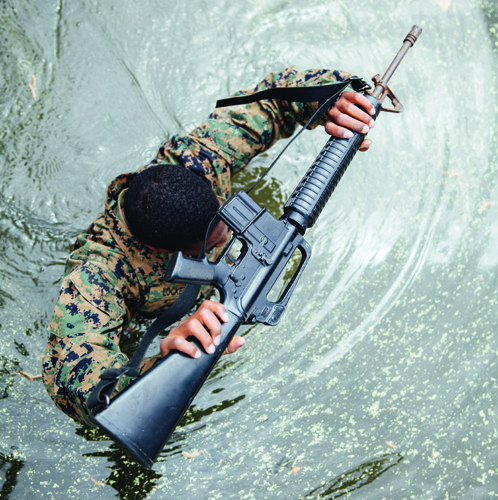
The “O Course” presents considerable physical, mental and emotional challenges for Tech’s Marine options and helps them prepare for the ordeals of Officer Candidates School.
O Course practice is meant to help orient midshipmen for the training they will receive at Officer Candidates School at Marine Corps headquarters in Quantico, Va. OCS trains and screens officer candidates to make certain they have the intellectual, physical and moral qualities expected of those who will be commissioned in the Fleet Marine Force. The OCS training is called BULLDOG, and this course time is BULLDOG Prep. At OCS, midshipmen are evaluated on their academics (25 percent), physical training (25 percent), and leadership ability (50 percent). They will be tested on weapons performance, knowledge of general military subjects and history, tactics, fitness, combat readiness, and their approach to leading peers—including peer evaluations. Townsend went last summer, right after completing his junior year.
“It’s a different beast,” he says of the six-week period. “Nothing can really prepare you for it. I was thankful I could come back and share my experience, to try and help the others get ready. But it will break you down. There’s no way around it. If they haven’t broken you down they didn’t do their job.”
They may have broken him down, but Townsend put himself back together. He completed OCS at the top of his class, a fact shared by someone else, and confirmed by Townsend somewhat reluctantly. None of what he did at OCS matters today, his expression says. Today, he’s interested in contributing to his friends in the platoon who have not yet been.
With the guidance of Staff Sgt. Vereen, Townsend explains what each midshipman must do to complete this afternoon’s workout. No one here, midshipman or active duty Marine, can recall the proper names of the different O Course obstacles or if the obstacles even have proper names (“how’s really friggin’ tall barrier?” one says, laughing). They just know what to do as they approach each one.
The course is a mixture of large wooden logs, metal poles and rope. There is the high bar that stands about8 feet tall, which you must propel yourself over. There are the double bars at an angle that you must reach by climbing, then shimmying yourself down inch by inch. Then there’s the high wall, about 6 feet high, followed by several lower wooden bars and another high bar. Once they finish that, they must climb up a rope and touch the top that stands about 12 feet high. That’s just the beginning.
The obstacle section is followed by a 2-mile run with a 9-pound dummy M16 rifle in-hand, then a low crawl through muddy grass. Still clutching the M16, the midshipmen must race over to the faux Quigley, a giant outdoor tub of black-colored water, bug-infested and covered with pollen. They will walk into the abyss, down one side, up the other, as the water creeps chest-high at the crux of their exhaustion, all while singing the Marines’ Hymn.
“This is a lot better than the Quigley up in Quantico,” Vereen says.
The Quigley is a water obstacle infamous in the Marine Corps for its nastiness and difficulty. Officer candidates must navigate its cement culverts, logs and barbed wire. It’s named for Lt. Col. William J. Quigley, who strove to better prepare troops for Vietnam. This tub, in comparison to what officer candidates will experience, is a session in a Jacuzzi.
The midshipmen will then tackle the obstacle course again, run another mile, then flip a tire large enough to fit onto a 7-ton truck for 20 feet. The tire for women is smaller and lighter. It also happens to be pink. Everything else is identical. The last run requires that the midshipmen carry a 30-kilogram sandbag over their shoulder for a last dash to the finish line. Then, only then, will they be done.
Townsend explains the course twice, and Vereen illustrates the proper technique for moving the tire. “If you don’t use your legs, you will throw out your back,” he says, looking in each midshipman’s face.
Townsend shares a few tidbits from his personal experience. “It’s important for your training,” he tells the group. “This will help you at OCS. All that being said…” He pauses to smile slightly, a genuine display of empathy: “This is really gonna suck today.”
The timer goes off and the first group gets started, two at a time. Townsend jogs alongside the pairs, encouraging each person by name, giving technical tips if someone gets stuck. Downing stands at the ready near the front line. She cannot practice, but she will not sit idly, either. As her fellow midshipmen pass her, she tosses out cheers and reminders of what to do next, when her winded counterparts look like they need help. Within the first few minutes, there are midshipmen at every stage in the course workout. Townsend fans out, dropping in to check on people as they make their way through.
Someone sprays down the muddy grass with a hose to make sure it’s muddy enough. The first midshipman hesitates at the low crawl, not sure how to hold the M16. Vereen shows him the proper placement, explaining how he must keep it both out of the mud but ready to engage in the case of enemy contact. The M16 slung over his back, he runs over to the makeshift Quigley.
“Tight to the right,” Vereen yells at a midshipman named Lockett. Vereen stands over the edge listening for the familiar lyrics of the hymn. Later, Lockett will admit he blanked out on the words. Vereen, a former drill instructor, is not about to let that pass. “You didn’t finish my song, Lockett!” He yells as the midshipman struggles out of the tub to the next obstacle. “You didn’t finish my hymn!”
While everyone seems to be in good shape, Townsend ascends the obstacle course himself. He wants to get a couple of quick runs on the bars, just for his own maintenance. He bounds through each high and low bar, up and over the high wall, and finishes with the rope. “He is so fast,” someone says. People nod.
Within the hour, almost every midshipman has completed the course. Townsend says his goodbyes—he has to make his senior seminar back on campus in about 30 minutes. He motions to his sweaty self: “They usually love me in there.”
In class, both Townsend and Downing bring the same level of commitment to their coursework that they do their future careers. Their schedules are rigorous representations of how much they love what they do, and how seriously they take the opportunities they’ve been given.
Neither Townsend nor Downing get much sleep. They’re up early to make 6 a.m. PT with the platoon every Monday, Wednesday and Friday at Piedmont Park. On Downing’s busiest days she starts off with class at 9:30 a.m., drills with the platoon (or leadership labs, as their instructor calls it) then an hour of PT, BULLDOG Prep, then class again from 4:30 to 6 p.m. “I don’t really get a break until the end of the day,” she grins.
The schedule can be taxing, Townsend agrees. But he recalls his time at OCS, saying it could be worse. “I was trying to study for a test. You’re getting 3-4 hours of sleep each night, so I’m falling asleep as I’m studying. It’s dark, because I’m using a red lens to read because that’s the only thing they let you use. I remember thinking, ‘I will never complain about school again.’” Of course, that didn’t last, he says. He still complains sometimes. But he appreciates the flexibility available.
“Even if you are in a stressful situation, you know that you can get through it if you put in the time and energy. No one’s stopping you from succeeding. Whereas at OCS, sometimes it felt like people were trying to stop you from succeeding—they’re kind of trying to weed you out.”
Being weeded out is still a possibility for both midshipmen. Downing still has to complete OCS this summer, and her participation may depend on medical advice about her hip injury. Townsend will face The Basic School (TBS) in the months following his commission, a six-month program that the Marine Corps uses to invest in the education, training and further evaluation of its newly commissioned officers. If OCS is a beast, TBS is a monster. Capt. Roberts believes both midshipmen will be just fine. He has glowing things to say about each of them.
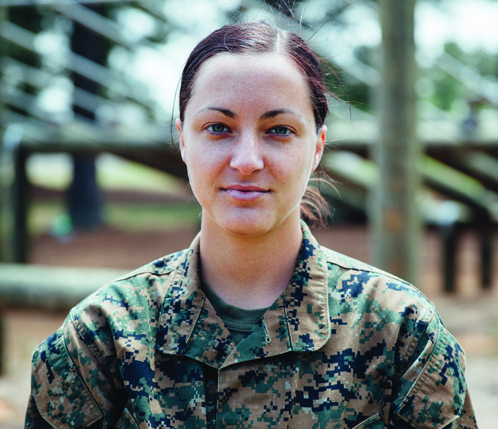
Senior Shelby Downing enjoys the structure that ROTC adds to her life as a student, even though it calls for an extremely demanding schedule. She’s up at 6 a.m. for physical training with her unit three days a week, and on her busiest days she’s in class until 6 p.m.
“Downing is an intellectually gifted person,” Roberts says, and tells the story of her tenacity, her refusal to give up on becoming a Marine option. Then he cites Townsend’s development as a leader, a senior who has come far and is leaving soon—someone who has been prepared for the challenge of being a junior officer, for the challenge of TBS.
“One of my biggest pet peeves is to have a Marine Officer focus inwardly, whether they’re physically hurt, tired, lonely, cold. Doesn’t matter,” Roberts shakes his head firmly.
“If you want to be a true leader you can’t worry about yourself. I look at Townsend and he gets through running a phenomenal run, almost Olympic athlete pace type-stuff,” Roberts says. “And he gets done and he doesn’t go over and lick his own wounds, he doesn’t sit on the side of the field and stretch out. Immediately when he gets done, he looks around and goes back down the course to find more people to help them finish at a better time.”
Downing anticipates the training OCS will give her one day soon. She wants to be able to lead her peers successfully. She looks forward to a potential career using logistics skills in combat engineering, or possibly going into intelligence. Townsend isn’t sure about what Military Occupational Specialty, or MOS, he’ll pursue, or if the decision will even be up to him. Much like the child he once was, he still just wants to be a Marine.
Downing, for her part, is determined to get there. She’s worked too hard, and seen her Navy ROTC friends work too hard alongside her, to not make it.
“They work their butts off for every grade they get, for every mile they run,” she says. “They have a lot of discipline. And they have a lot of heart.”
Photos by Gregory Miller and Justen Clay
TECH ROTC PROGRAM SNAPSHOTS
ARMY ROTC
Founded: 1917
Commander: Lt. Col Charles K. Chang, MP Professor of Military Science, YJB Commanding
Current full-time Georgia Tech cadets: 27
Full-time Georgia Tech cadet commissions in 2014: 7
Summary: The majority of students contracted to join the Army ROTC do actually commission as second lieutenants, and most cadets get the billets they desire upon graduation. Some may go on to active duty, the U.S. Army Reserves or the National Guard Reserve. Reserve and National Guard commissioned officers continue on to pursue civilan careers
Quote from Commander: “The Army ROTC is a great leadership training program, and we have a solid commissioning record. We posture students for success whether they are in the service or working in the corporate world.”
AIR FORCE
Founded: 1946 (though part of Army ROTC in 1920)
Commander: Lt. Col. Shawn Bevans, Professor of Aerospace Studies, AFROTC Detachment 165 Commander
Current full-time Georgia Tech cadets: 65
Full-time Georgia Tech cadet commissions in 2014: 6
Summary: Detachment 165 is a recipient of the High Flight Award (2011, 2013), which recognizes Air Force ROTC excellence in the region. It also received the national honor Right of Line, #1/53 units (2011, 2013). Both awards measure students’ GPA, fitness ability, community involvement and the number of STEM majors in the program. Graduates become pilots, combat system operators, cyber officers and oversee remotely piloted aircraft.
Quote from Commander: “This detachment sent 100 percent of our officers who wanted to fly into rated positions in 2011 and 2013. In 2012, we were at 80 percent. In general, the Air Force sits at about 75 percent. If you really want to fly, enrolling in Georgia Tech’s AFROTC is the way to go. The Air Force has great careers in space, cyber and key logistics and support functions.”
NAVY ROTC
Founded: 1926
Commander: Capt. Mario Mifsud, Professor of Naval Science
Executive Officer: Lt. Col. Christi Saddler, Professor of Naval Science
Current full-time Georgia Tech midshipmen: 49
Full-time Georgia Tech midshipmen commissions in 2014: 2
Summary: A midshipman in the NROTC will attend mandatory drills twice weekly, where sessions cover current events, personal finance, CO briefs, and response to assault or hazing. Naval Science courses are scheduled throughout the midshipman’s tenure, ending with leadership and ethics, where students apply military law and philosophy to real-life challenges that a junior officer might encounter.
Quote from Executive Officer: “Our students take eight Naval Science classes, four additional calculus and physics courses, a physical fitness test and summer training. That’s about 40-plus hours added on to their major coursework. You have to really to become an officer and serve your country.”
MARINES (NROTC)
Current # of midshipmen: 15
Full-time Georgia Tech midshipmen commissions in 2014: 3
Summary: The mission of the Marine program is to develop the midshipmen to become a leader of Marines. The goal is to train midshipmen to the highest possible mental, physical and moral standards for prompt, active service in the fleet Marine force.
Quote from Executive Officer: “We’re primarily war fighters. Our commissioned officers must be able to think tactically so Marines under their charge will act decisively. It’s a rewarding job seeing students grow and mature from when they first join the unit, asking questions, to taking charge and planning the training schedule themselves.”




 Twitter
Pingback: Accolades from Atlanta : SCAD Writing