


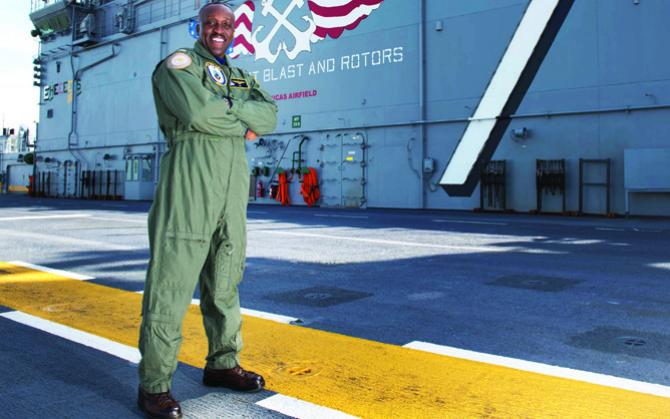
Managing any kind of enterprise has its challenges. But try putting it afloat, then feeding and providing sleeping quarters for 3,200 of your closest colleagues—all while keeping them ready for combat or humanitarian relief missions. That’s just part of what U.S. Navy Capt. Dana R. Gordon, EE 89, does as executive officer of the U.S.S. Iwo Jima—a Landing Helicopter Dock class amphibious assault carrier in the U.S. Navy fleet. Gordon’s job description may sound simple and straightforward: As the Executive Officer (XO) he runs the day-to-day operations of the ship. “But it’s far more complex than I could have ever imagined,” Gordon says.
The Tech alumnus and Columbia, S.C., native manages 16 different units on the ship and directly oversees a cadre of department heads, officers and chief petty officers. He’s responsible for the 1,100 Navy sailors on board, who in turn are responsible for feeding and housing the 2,100 Marines who man the ship’s aircraft and amphibious assault vehicles. Gordon’s sailors also run the ship’s propulsion plants, provide fuel, repair and maintain the ship and aircraft, and offer medical and dental care to everyone aboard. Talk about logistics.
A heavily decorated Naval officer as a helicopter pilot and helicopter squadron commander, Gordon has made his workplace on the high seas and the skies above it—working on five continents and in 17 countries, and sailing on every major ocean except the Arctic during his 24-year Naval career. That’s one way to avoid the typical office view.
Gordon is halfway through his 18-month stint as XO of the Iwo Jima, training under the current commanding officer (CO) to eventually rotate into that role. As CO, he will then have full command of the 40,000-ton, 884-foot long ship—which is equipped for missions ranging from Marine combat to disaster relief—for another 18 months.
Charged with getting the best performance from the crew and protecting their welfare, the long-time aviator trained for a year to learn how to drive the ship and understand its various systems. Now he knows not only how to handle the carrier, but also how to provide the roughly 10,000 pounds of food per day to feed the full crew—including supplies for the 18,000 pancakes per month that keep his sailors happy.
Despite his Navy ROTC training at Tech and his extensive Naval experience, nothing prepared Gordon for the level of problem solving required to manage the equipment and personnel on the Iwo Jima. “There really is no training for it anywhere,” he says. “My role demands incredible levels of coordination and a ton of teamwork.”
Gordon likens his role to that of an NBA point guard. “I always loved the great pass that led to a successful basket,” he says, reminiscing about his college days shooting hoops with friends on campus. “That’s what I get most out of this job as XO and eventually as the CO—the satisfaction of seeing those who work for me succeed.”
His current work to-do list includes relocating the Iwo Jima, its crew and their families from Norfolk, Va., to Jacksonville, Fla.—part of an initiative to disperse Navy assets along the East Coast. The change will reunite Gordon with his wife and two daughters, who stayed at their home in Jacksonville during his various assignments in recent years.
As he works toward his eventual role as CO of the Iwo Jima, Gordon credits his education, experiences and NROTC training at Georgia Tech for fostering the right mentality to help him take on his unique, high-level workplace challenges. The deductive reasoning and problem solving skills he learned while studying to be an engineer stick with him today, and his rigorous education prepared him to memorize the intricate systems on which his life depended as a pilot and, now, as XO of a combat-ready ship.
“Tech is a tough school, but that foundation and hard work clearly prepared me for this role,” Gordon says. “That mindset of getting things done—and done well—certainly started there.”


 Twitter