


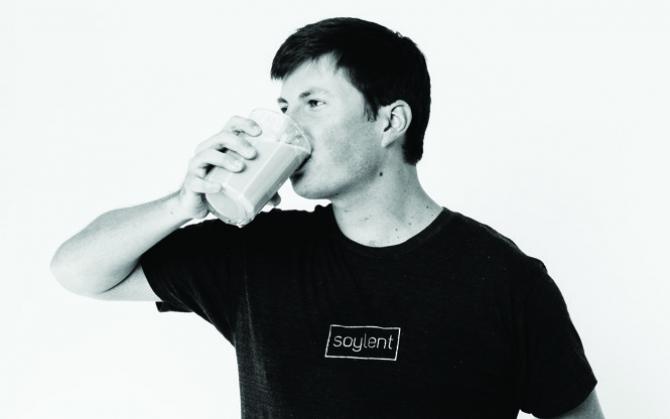
Before Rob Rhinehart, CS 12, designed a completely new food source from scratch, he basically survived on two core food groups—red meat and pasta. “It wasn’t particularly healthy,” he says. “But I liked foods that packed calories, were easy to prepare and were affordable. Now I have a better version of that.” That better version is Soylent, a powder that when mixed with water, comprises the elements of a complete and healthy adult diet replete with calories, protein, carbs, fiber, vitamins and even a little fat. The thick, beige-colored liquid with a mild taste (some have said it reminds them of pancake batter) might appear like a mere substitute for the fruits, vegetables and meat that we rely on. But Rhinehart is unfailingly clear: Soylent is food, albeit with a far more efficiently engineered approach.
For Rhinehart, food—at least the version that most people recognize—has largely been a hindrance. After graduating from Tech, he moved to San Francisco upon landing a job developing wireless communications for startup Y Combinator. The inherent shortages of the entrepreneurial life (a fixed cash flow, never enough time to take care of all of daily necessities) began to take their toll. A self-defined minimalist, Rhinehart was inspired by his work but increasingly frustrated by how “the bottleneck” of eating kept interrupting the flow.
“We could solve our engineering problems, optimize, and make a lot of our products and processes more efficient at work,” he says. “But food always got in the way.”
When he tried to eat healthfully, food was time-consuming and expensive. When he cut corners for the sake of his energy and wallet, he’d end up chowing down on peanut butter sandwiches or cheeseburgers almost every day.
Rhinehart wanted to eliminate the waste in this food bottleneck so he could get back to learning and working. He hated the menial tasks food required, like driving to the grocery store, standing in line, preparing food, then cleaning up afterwards.
He could have avoided those chores by hiring someone else to do them for him. But Rhinehart began to consider the food issue as an engineering problem, which meant no outsourcing was needed. What if he could design an alternative way for human beings to get all the necessary nutrients? What if he could optimize how we can prepare and consume healthy food?
To build the process of eating food into an effective, streamlined system, Rhinehart decided he needed to start from scratch. In the summer of 2012, inspired by a roommate who had studied biology, he says he noticed parallels between electronics hardware and human biology. Sure, the body was a “messy and noisy” system, but it was robust. If he could gather the right ingredients and transmit them to the body in an accessible, convenient way, he’d be on to something. He began looking at food the way a programmer would design software, by starting with the individual components.

Rhinehart researched the various nutrients the human body needed, ordered them online and tested the recipes on himself. “I hurt myself a little when I got some of the amounts wrong,” he says. “But I survived.”
Rhinehart blogged about his project and shared the recipe-in-progress for Soylent on Reddit, a social networking website where community members post questions and trade tips.
Comments soared. People launched their own trials based on his core formula, testing out unique recipes based on flavor or dietary preference.
Rhinehart said that drinking Soylent every day had given him a better lifestyle—one of his own design, free from the constraints of standardized food consumption. He subsisted almost exclusively on Soylent alone for almost a year, and he says his health and energy improved dramatically. He was joined by a host of believers who discovered much the same benefits.
By early 2013, his wireless communications startup was on the back burner and Rhinehart and his team relocated to Los Angeles. They brought Soylent to the crowd-funding site CrowdTilt in May, offering supply packages of the sustainable powder for one week, two weeks or one month for varying levels of donations. His total ask for just $100,000 more than succeeded—the campaign has raised a whopping $3 million by March 2014, funded by more than 20,000 backers.
Along the way, Soylent gained an additional $1.5 million in a seed round of financing. He was officially in the food business now—Soylent is regulated by the Food and Drug Administration. But the engineer soon found himself in a strange predicament, facing inquiries as to why he wanted to stick a fork in food.
“We’re not targeting your dinner party,” Rhinehart says of the skeptics. Special nights out and birthday celebrations still have a place in his heart (and belly). “It’s important to realize though, those occasions are more about the people than the food. It’s the conversation, the camaraderie, that I see as the real pleasure.” But that $30 entrée many ooh and ahh over: “It’s just something that’s there.”
Soylent is challenging the staple meals, the ones that Rhinehart says take up 40 to 80 percent of our dining life. He would like for us to trade hurried breakfasts scarfed down en route to work and stressed-out lunches inhaled pre-deadline for a subscription to Soylent. (Supplies start at $70 per month for 21-plus “meals”.) Staple meals are usually where people have the most problems, he says, in terms of maintaining a healthful diet. That’s where Soylent just makes sense.
Naysayers don’t bother Rhinehart—he’s certain that food as a biotech venture will only increase as time goes on and our agricultural resources are exhausted. Perhaps his view is a natural perspective for someone who lingered in the sci-fi and philosophy sections of the library as a kid. Growing up in the Atlanta suburbs, Rhinehart read Make Room! Make Room!, the Harry Harrison novel about the dangers of population growth that inspired the Charlton Heston film Soylent Green.
It’s important to note that Soylent Green changed the novel’s plot and theme considerably, with Heston’s character at the end of the movie realizing that the titular foodstuff created to feed people “is people!” Rhinehart has embraced that irony with his wry sense of humor and didn’t flinch from any confusion the name Soylent might create among those more familiar with the film than the book.
Even when he was just 8 years old, Rhinehart says he deplored the food waste in dumpsters. As he got older, that disgust transferred to the massive amounts of land and labor swallowed up by the industrial food supply chain. “I guess I’ve always intuitively realized that it wasn’t going to scale all the way,” he says. “It’s too chaotic. That idea of having a cheap, essential staple called Soylent that the population lived on in the book, I guess that made a lot of sense to me.”
Apparently, Soylent appeals to a diverse group of people, from consumers to potential business partners. Rhinehart won’t disclose the company’s earnings or how many customers they serve, but he says they’re profitable. Even the U.S. military and NASA have come calling, and partnerships with NGOs are in the works so Soylent can be used in an aid capacity to developing nations.
But that’s all down the line. Today, Rhinehart continues to test product developments, study food science and and manage Soylent’s ever-volatile supply chain. He was worried that the food business would push him toward becoming a marketer rather than an engineer. However, he discovered that Soylent keeps him in a challenging design environment, where he gets to play with taste profiles and a complex e-commerce infrastructure.
More than anything, he’s enjoying his freedom. Rhinehart says he hasn’t been to a grocery store in years and he never does the dishes. The contents of his fridge? Beer and Soylent. “I still eat regular food,” Rhinehart says. “I just eat the meals that I want to.”
The best benefit of Soylent, Rhinehart says, is seeing how it impacts people’s lives in such a personal and profound way. He anticipates many more changes on the food landscape. And those skeptics—he thinks they should loosen up.
“Food has always changed, and it’s going to continue to change,” Rhinehart says. “It’s not sacred.”


 Twitter