


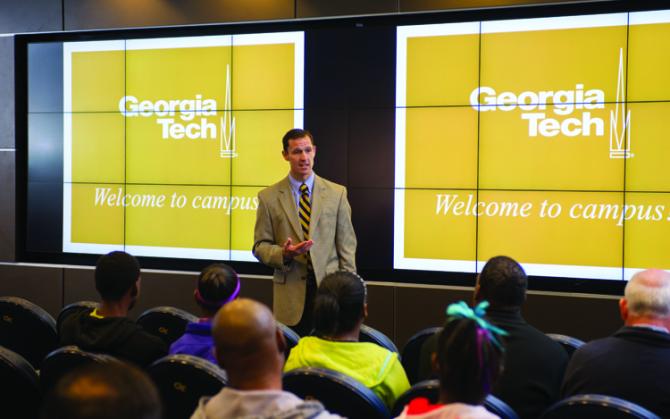
With the number and quality of applicants steadily increasing, the competition for freshman admission has never been higher at Georgia Tech. In fact, in sheer statistical terms, it’s harder to “get in” than it is to “get out.” With the 2015 college application season now well underway, the Alumni Magazine asked Rick Clark, director of undergraduate admissions, to speak openly about the new realities of getting into Tech and share some tips for parents gearing up to help their kids through the complex admission process.
Just six years ago, 62 percent of students who applied to the Institute were accepted. However, in 2014, the acceptance rate stood at only 33 percent—about the same rate as highly competitive private schools like Wake Forest and Boston College—and it could keep getting smaller.
Last year, Tech moved to the Common Application, which decreased the admit rate approximately 8 percentage points, Clark says. “Applications soared to an all-time high of 25,872, compared to 9,988 in 2008,” he says. “And while Tech is growing, there’s a limit to the number of incoming students we can accommodate and continue to deliver excellent instruction and access to necessary resources.”
That said, looking at the makeup of the 2014 freshman class, it’s still no easy task to become a Yellow Jacket. The average SAT score (including the written test) of this year’s enrollees was 1450, the ACT 30, and the GPA a solid “A” average. In addition, 94 percent of Tech’s freshmen this year took at least AP
calculus or its equivalent while in high school.
“With those scores and grades, it’s clearly a challenge for students to separate themselves from other applicants,” Clark says. “That ‘A’ average, for example, includes an average nine Advanced Placement, International Baccalaureate or dual-enrollment classes per student.”
But, according to Clark, high school academic scores and grades are just one factor in the admissions process, albeit a very important one. “Statistically there’s not much difference between an SAT score of 1350 or 1400 when it comes to predicting how a student will perform in college,” he says. “That’s where extracurricular activities, personal essays and recommendations come into play and help us make decisions about which applicants are the best fit for Tech, and vice versa.”
For high school seniors (and their parents) looking to separate their applications from the pack, Clark offers the following tips:
1. Be “pointy” rather than well-rounded. In the past, admissions officers searched for well-rounded students who held a great breadth of experiences. Now, however, Clark and his staff—and admissions officers across the country—keep their eyes peeled for “pointy” students who instead have deep interest and skills in a narrower range of pursuits. “Applicants who demonstrate an early passion and have been able to stay focused on it over a number of years really stand out. They’re much more likely to succeed and thrive at places like Tech.”
2. Use the personal essay to make a connection. “Believe it or not, we read every essay,” Clark says. “But far too many students simply regurgitate what’s already apparent in their application materials. What we want to read is writing that showcases an applicant’s personality, passion and voice.” With the in-person interview no longer a common part of the admissions process nationally, the essay needs to make a strong impression, Clark says.
3. Make parents your partners. The admissions process can be stressful for students and parents alike. “Instead of putting pressure on their kids, we encourage parents to create a partnership with them,” Clark says. “Parents should be in the crow’s nest, scouting out the process, but ultimately students are captains of the ship. When parents take over, students tend to shut down and tune out—which only makes parents more determined to force the issue.” Clark suggests that parents and students should set up safe times and spaces each week for talking about college and strategies for applying. “An early, honest, open dialogue with clear expectations is critical to everything going well,” he says.
4. Remember it’s about fit. “It’s far more important that a student makes the right choice than it is for their parents to have a certain college bumper sticker on their car,” Clark says. Besides, when students aren’t really sure they’re applying to the right college, their lack of commitment and excitement typically shows up loud and clear in their application materials.
5. Don’t assume that because you’re a legacy, it’s a lock you’ll get in. This goes for both students and parents, as there are just too many factors at play to ensure all legacies will get into Tech. “It’s still a factor we consider, to be sure,” Clark says. “Children and siblings and grandchildren of alumni typically demonstrate a great loyalty and passion for Tech, and we value such positive, long-term connections. But in the end our goal is to enroll the best overall freshman class possible.”
6. Apply even if you’re not an engineer. “Tech has changed a lot, especially over the past 20 years,” Clark says. “We have a number of nationally respected programs from business to design to liberal arts. What makes Tech special is the commitment to a rigorous education that prepares you for a successful career, and that’s supported by the Institute’s ranking as the No. 1 return on investment among U.S. colleges.” Clark says that a class composed of students with a variety of academic majors ensures that Tech will continue to be well respected in all fields.
7. Celebrate your success. Getting into college is a major achievement, no matter what college it is, Clark says. “After all the hard work that goes into the process, you need to celebrate each win and get excited about your hard work being recognized,” he says. “Embrace the schools that admit you and the opportunities you have in front of you, and don’t dwell on schools that do not offer you admission.”




 Twitter
My grandson, Ian Trobaugh has applied and meets all the requirements mention in this article. I am an Alumni and I hope he will be accepted, its been a long time dream of his.:t