


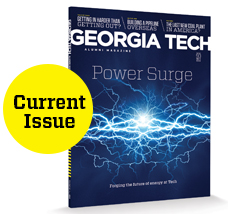
 When we first started talking about energy as a theme for this issue of the Georgia Tech Alumni Magazine, the sheer breadth of the topic daunted us. Just consider the stories we could cover: oil and gas production, nuclear, coal, hydropower, wind, solar, geothermal, biofuels, sustainability, batteries, electric cars, clean energy, pipelines, transportation, carbon footprints, LED lighting, energy efficiency, public policy, cap and trade, energy independence, climate impact—the list goes on and on. It would take a thousand pages and we still couldn’t do the justice to the theme. So, instead, we’re going to share some of the highlights of how Georgia Tech faculty, researchers and alumni play a critical role in the global energy industry today.
After the 1964 World’s Fair, one of the greatest science-fiction writers and futurists of all time, Isaac Asimov, made some predictions—many of them pertaining to energy—about what the year 2014 would have in store for us. Here’s one of them he shared with The New York Times:
The appliances of 2014 will have no electric cords, of course, for they will be powered by long-lived batteries running on radioisotopes. The isotopes will not be expensive for they will be byproducts of the fission-power plants which by 2014 will be supplying well over half the power needs of humanity.
Asimov’s projections were a bit off, as only about 12 percent of the globe’s electricity is provided by nuclear power. And, of course, most appliances are still not wireless (though we’re getting there!), nor are they powered by isotopes. But given that it was a 50-year-old forecast, he still gets an “E” for effort.
More recent predictions about energy have also proved to be wrong, demonstrating just how fluid (pardon the pun), the science and technology can be. For instance, you don’t have to think too far back to recall the hysteria of gasoline shortages of the 1970s and the whole “peak oil” scare, which postulated that oil production would decline precipitously in a bell-curve fashion and we’d inevitably run out of this precious natural resource. Yet here we stand, just a few decades later, with the picture altered dramatically, as innovations have led to hydraulic fracturing and horizontal drilling and the nation’s largest oil and natural gas reserves on record.
What we do know to be true, however, is that there is no one single energy source that will solve all our challenges, no magic bullet. It will take all sources of energy and ingenuity at our disposal to continue to feed the world’s growing energy demand. And Georgia Tech and its alumni and faculty are helping to lead the way and taking on the challenges of developing new technologies—and policies—to make energy production and delivery more efficient, renewable, cost effective and safe.
JOE IRWIN, IM 80
PRESIDENT & CEO
GEORGIA TECH ALUMNI ASSOCIATION


 Twitter