


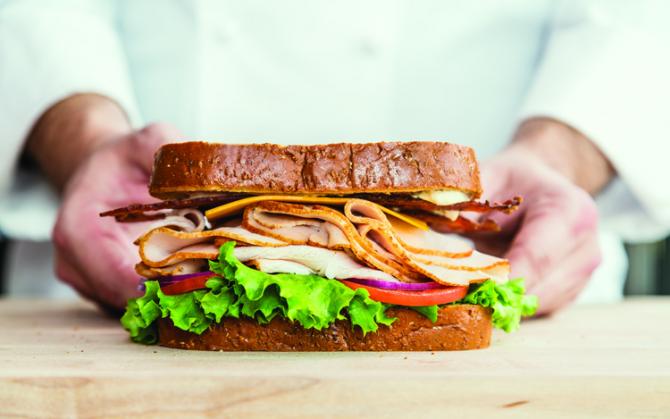
Getting a new menu item to an Arby’s location near you is no small feat for the executive cooking team based at the corporate headquarters test kitchen in Sandy Springs. It takes the work of five dedicated food professionals to create tasty products that are cost-effective and fulfill on the promise that the Arby’s marketing effort has spread to the masses.
Led by executive chef Neville Craw, the group includes two food scientists, a chef dedicated to product development and sous chef John Miller, who took us through an average day on the job.
Long before a sandwich, side item or milkshake can become the inspiration behind a customer’s smile, a simple sketch of the product starts out in the ideation department, where the staff brainstorms key concepts, ingredients and even potential mash-ups. Once the elements are agreed upon, the product goes to research and development. This is where the test kitchen staff tries out the ingredients and evaluates the cooking process, even considering which vendors to use.
Of course, there’s the tasting. A lot of tasting happens in the test kitchen. “You can see all the bottled water we have,” Miller says, pointing to a glass-door refrigerator. Almost every shelf is packed with water bottles, each row about three deep.
Depending on the day’s agenda, test kitchen hours start around 6 a.m. Staff members have their own work areas where the focus may be on the shake station, the fryer or the work line that closely mirrors the equipment and space available in an average restaurant. (Note: everyone ought to have a cheese pump, for the warm, melted goodness that tops off an Arby’s Beef and Cheddar.)
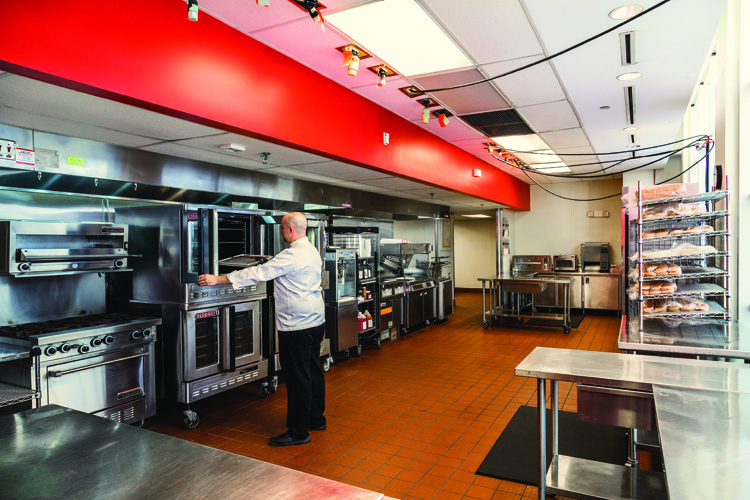
The food scientists can share the kitchen when needed, but they also have their own office space to focus on quality assurance. Here, you won’t find meat slicers or stoves. Instead, you should be on the look out for microscopes. This is where each item is closely examined for food safety reasons and to ensure the cooking process meets restaurant requirements.
After satisfying the rigors of R&D, the new product goes through operations integration. This stage ensures that every Arby’s kitchen can execute the item consistently and deliciously.

Even if a product seems perfect in the test kitchen, it must pass store testing to make it to an Arby’s menu. The recipe and ingredients are sent out to actual Arby’s restaurants. Now the test kitchen team awaits feedback. Was the product easy to execute in production? Did team members report issues? Most importantly, what did the guests think? Such analysis is key. If you’re going to roll out a new product to hundreds or thousands of locations, that sandwich better sell. It ought to make people smile, too.
When a product is finally added to the menu, it has likely been under consideration by the test kitchen team for anywhere from six months to one year.



 Twitter