


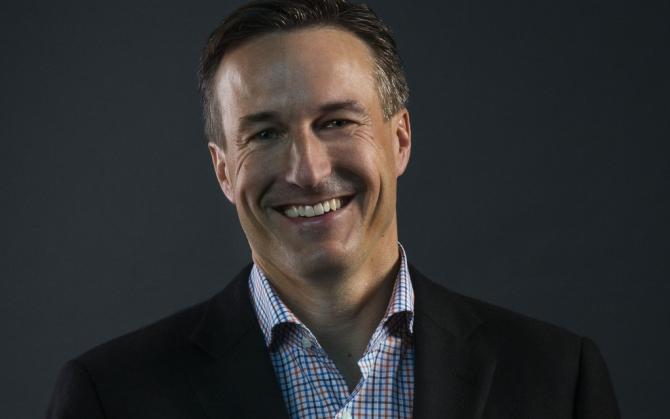
In the fall of 2013, Arby’s Restaurant Group CEO Paul Brown sat down with his leadership team at a planning retreat.
Brown had jumped into his new role in the spring of that year, leaving behind his post as president of brand and commercial services for Hilton Worldwide. If all went the way he intended, this important off-site meeting—the capstone of six months of methodical research and data analysis—would set the tone for the company’s direction for years to come. Arby’s needed a jolt to to revitalize the brand. Pretty much everyone was in agreement on that.
The previous decade had been a rough ride for the 50-year-old fast-food brand known for towering roast beef sandwiches and delightfully curly fries. Though by the time Brown, 47, took the helm at Arby’s, he says the company had already done much to start “righting the ship.”
In 2008, Arby’s had joined forces with Wendy’s and went public as the Wendy’s/Arby’s Group. Arby’s earnings were already trending behind its competitors before the economic downturn of that year, but the challenges of managing a merger in the midst of the ensuring recession did not make matters easier. As if that wasn’t enough, the innovation pipeline was not operating anywhere near capacity. Sales were dropping and the next great ideas simply weren’t there.
It did not come as surprise to most when in 2011, Arby’s was spun back off on its own. The next move, however, did make a few heads turn. Arby’s waltzed into the arms of Atlanta-based Roark Capital Group, an investment firm specializing in franchise concepts (Moe’s Southwest Grill, Cinnabon and Corner Bakery Cafe among them). For the sale price of $130 million plus another $190 million in debt, Roark took Arby’s private and began steps to stem the decline.
The firm also started looking for someone who could push Arby’s to the next level. The new investors wanted a leader who could both envision the growth opportunities of increased sales with newly added locations, while also seeing the process through. All the players believed in the brand’s potential to make its mark, but helping the ship right its way was only the beginning. For Arby’s to weather the journey ahead, the ship was going to need a new captain.
***
Brown carries a relaxed presence at the Arby’s North Atlanta restaurant support center. He smiles at strangers in the elevator and speaks in even, measured tones, even when expressing excitement. While being interviewed for this article, the married father of two apologized for taking a pause—he needed to answer text messages from his college-aged daughter, who had just returned home for winter break. He highlights the great work done by people on his team and casually references books that have impacted his own development: Simon Sinek’s Start with Why and Daniel Pink’s A Whole New Mind, which discusses why right-brainers will rule the future. Brown is laid-back enough that it’s easy to forget this guy runs a multi-billion dollar brand with 3,400 locations throughout the U.S. and abroad.
Born in Georgia, Brown spent the majority of his childhood in metro Atlanta. Attending Georgia Tech seemed inevitable. “My father was a Georgia Tech grad. My brother went to Georgia Tech. An uncle of mine went to Georgia Tech.” He shrugs, smiling. “So that was one of the reasons why I ended up going to Georgia Tech.”
While studying to earn his bachelor’s degree in management, Brown maintained a busy extracurricular schedule and served as president of the Interfraternity Council. Right after graduating, he worked as a software engineer on a Delta Airlines project for Anderson Consulting. Five years later, he headed up to Northwestern University, where he earned dual master’s degrees in business administration and engineering management.
Retail and hospitality piqued his interest in his next role as a consultant for the Boston Consulting Group and a partner for McKinsey & Company. But Brown says his first major management responsibility came at InterContinental Hotels, where he oversaw brands such as Holiday Inn and Crowne Plaza. He eventually followed that with a move to Expedia.com, where as president, Brown says he learned to flex his marketing muscles. He prizes the time he got to work with Expedia Chairman Barry Diller, a legendary entrepreneur and marketing expert.
“Barry is one of best marketing guys ever,” Brown says. “I learned a lot of lessons from him.”
At Hilton, Brown got the hang of building a strong culture and admired the CEO’s ability to align a workforce behind clear company values. During Brown’s tenure, Hilton reached its highest market share level in the company’s history.
“I’m applying learnings from all aspects of my career,” Brown says. “Maybe there are downsides to having as many experiences as I’ve had along the way. But the plus side is you’ve seen so many different things, and you can pick and choose the best.”
It’s a helluva trail to blaze. But if Brown’s career navigation sounds like a curious passage to leading a restaurant company, especially one that was aching to find a strong, steady current, that curiosity would be well-placed. His was not the most direct route.
Still, Brown sees the parallels. And perhaps more importantly, so did Roark Capital Group.
“I specialized in marketing and finance,” Brown says, “but the engineering management part of my work has been overseeing manufacturing processes or running large, complex facilities. That plays into part of what I’m doing now. Because if you think about a restaurant company, each location is a mini manufacturing plant, as well as a retail facility.” He nods in thought, then adds, “It’s fairly complicated.”
Brown was up for the challenge, and his mandate could not have been more clear: Make Arby’s work.
“Who are we?”
That was the question floating above everyone’s head at the Arby’s 2013 planning retreat. Brown believed that Arby’s had to define what it was about before the company could take any meaningful action. It was a brand in existential crisis. During the 10 years preceding Brown coming on board, Arby’s had tried a string of different marketing approaches. And they all failed to deliver sustained success.
The logo kept changing: Remember the oven mitt? The tagline “I’m Thinking Arby’s” stuck around for a little while, then it was dropped for no tagline. A year later, “I’m Thinking Arby’s” returned, only to give way to two others soon after: “Good Mood Food,” then “Slicing Up Freshness.” Such incessant, seemingly frantic change didn’t fare well compared to the long-term, consistent brand messaging of its myriad competitors. The Arby’s brand focus seemed to be in constant flux, but nothing ever felt right.
SEE RELATED STORY: Inside the Arby’s Test Kitchen
So at this important meeting, away from distraction, Brown charged his leadership team to figure out the purpose of Arby’s. This would be no small feat for the new captain and his crew. But they had come prepared. A great deal of insight had gone into setting up the meeting. Brown had reviewed so much customer research filled with spreadsheets, graphs and numerical columns, that later he could only describe the quantities as “reams and reams and reams.” He had spent the last six months listening to franchisees, stakeholders and restaurant team members. He wanted to squeeze out every bit of experience he could. He wanted to connect with anything or any person who could help tell the story of Arby’s—what it had been, what it should be, what was possible down the road.
But they had to start with the why, a philosophy Brown believed in even before he read Sinek’s management book on the subject. “I wanted us to have a clear overarching purpose statement that would survive for decades,” Brown says. “Everything needed to add up to that.”
At the off-site meeting, the executive team developed a purpose statement worth keeping: “Inspiring smiles through delicious experiences.” That was it, simple and straightforward. And out of that statement, a new clarity emerged. Remember all that potential Roark saw in Arby’s? Suddenly it was obvious. The Arby’s identity was rooted in the food.
“The reason you see a lot of sleight of hand in this industry is because some companies don’t want to focus people too much on the food,” Brown says. But for Arby’s, he says, “it’s really delicious food. And I’m not just saying that.”
Hot, sliced roast beef sandwiches had been at the core of Arby’s since its 1964 beginning. And over the years new classics were created—the roast beef sandwich with warm cheddar cheese sauce, fried chicken, corned beef, Angus steak, roast turkey and most recently the 13-hour smoked brisket. If Arby’s cut out all the other marketing noise and just focused on delicious food that made people smile, how would the brand change? To find the answer, it was time to start dreaming.
The executive staff began developing a vision for the brand based on its core purpose. What would being inside an Arby’s feel like? What would customers say? Brown could see the ground shifting. Now, he had to get buy-in from everyone else—the franchisees and the team members—the people who were going to make this vision become an actual, edible reality. There’s just one thing about charting new territory across thousands of people in thousands of locations: When some of those people have been with a brand through the roughest of times, it can be hard to dream. Cynicism can sometimes become an obstacle to purpose statements and brand visions. But Brown was ready for that.
Five to seven. That was the mantra.
A holdover from exercises Brown used at Hilton, he found this one to be especially useful. Look out five to seven years, and you’d hit the sweet spot. It was far enough away so people could let their imaginations play, but not so close to incite panic.
“You can get a lot more alignment if you talk about that many years out, than if you talk about next year,” he says. “Once you spend time getting everybody aligned around what things look like in that span, then you come back and say ‘OK, what does that mean specifically for year one, two, three and four?’”
After poring over the research and analyzing how Arby’s had recently struggled as a brand, Brown and his team named the vision “deli-inspired delicious.” The team imagined beautiful sandwiches artfully presented with wax paper, the fresh ingredients peeking through an intentional opening. They envisioned chalkboard-style menus with items written in elegant print, where the names of the food items tell you precisely what they are.
The restaurants would have to look different, too. Fluorescent lights disappeared from this vision, as did laminate tables and boxed-in windows, typical fare for the average fast-food joint. The team was inspired by New York City’s Chelsea Market and Eataly—teeming with natural materials such as red brick and wood, and elements that reflected light, such as glossy white subway tile. In their vision, larger windows ushered in the light, pendant lamps created a soft environment, and wood panels lined the walls.
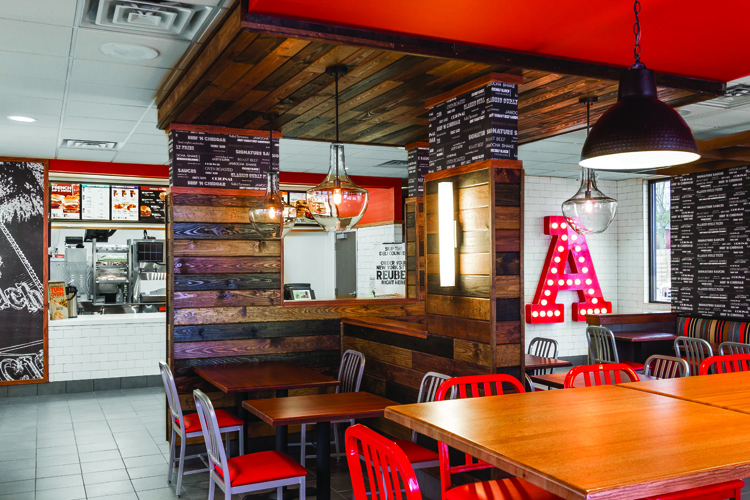
Arby’s new branding vision includes updating the interiors…
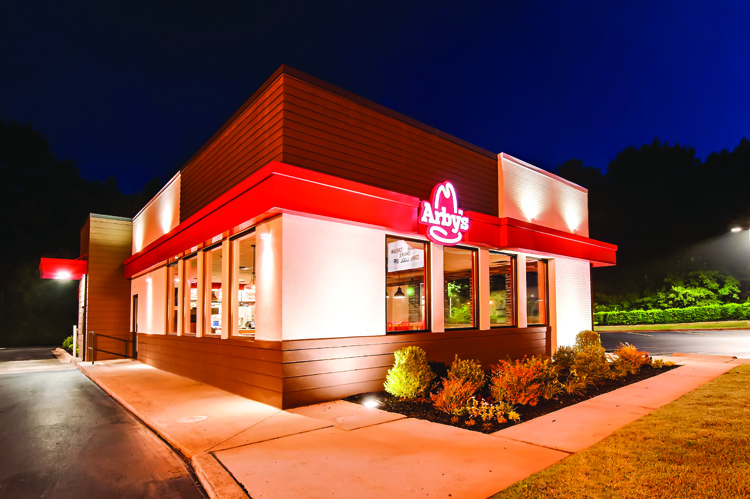
…and exteriors of its restaurants.
Now, they realized, they weren’t just talking about fast food anymore. But it wasn’t quite fast casual either, a la Chipotle. They decided that deli-inspired delicious was it’s own thing—“Fast Crafted”—somewhere in the middle. Brown believes Arby’s offers a better experience and product than fast food, and when compared to fast casual stores, he says Arby’s has comparable food that’s less expensive and more convenient. If they were successful in executing this vision, within five, six or seven years, customers would walk into Arby’s locations that looked, felt, smelled and served food based on this ideal.
Brown would need people far beyond his executive staff to implement these changes, however. Arby’s was and still is a franchise system. “There are a lot of people to get aligned,” Brown says.
Of the nearly 3,400 restaurants, the company owns and operates just more than 940 locations. Of the remaining franchise-owned, almost 400 different franchisees run those restaurants.
The process of getting everyone on the same page was “as much as anything, the galvanizing, seminal moment on the journey thus far,” Brown says without a hint of exaggeration. “It was a balancing act of going fast enough because there’s an urgency around the business, but going slow enough so that you’re bringing the right stakeholders with you along the way.”
Brown wanted the franchisees to have the same inspired smiles that his executive staff had when this deli-inspired delicious vision was discussed. But his team had enjoyed the benefit (or the curse) of seeing all the data. They had paged through the research and gone to the off-site. He couldn’t expect the same level of enthusiasm from people who, while committed to the growth of Arby’s, did not have access to the same information, nor the time to process all those reams and reams.
So, Brown made a key decision. He branded the brand vision. Working with his marketing staff and an external agency, he created a brand book that told the story of this soon-to-be emerging Arby’s. This was not boring, corporate homework. No consulting PowerPoint slides here. The pages of this giant book begged to be opened, the bright red cover as wide as the picture books of one’s childhood. Make no mistake—the data was in there. But the
Arby’s story was told in a narrative format that was digestible, brief and accompanied by gorgeous photos that illustrated precisely what the words stated. The book and its Pinterest-style image galleries did what Brown and his team wanted future Arby’s locations to do—it created an experience.
“This was the Arby’s I fell in love with when I first started,” one franchisee told Brown.
“Finally, we’re back to focusing on all the great food we have,” said another. “This pulls it all together in a way we haven’t seen before.”
But it wouldn’t be a conversation with a franchisee without this response: “Wow. That looks like it could be expensive.”
Brown followed the book with countless conversations. Assurances. More explanation on what this would mean, how it would work. And there were focus groups—so many—with customers and potential customers. Still, Brown knew he had to reach the service staff, and in a personal and profound way. That was going to be a challenge.
“We employ 21,000 people, and across the whole system it’s more than 70,000,” Brown says. Flying all over the country or sending a mass communication was not going to articulate this vision in the way it needed to be expressed. Brown approved an idea from his vice president of guest experience and developed Brand Camp, a half-day, off-site training exercise where all the team members of a particular location would get introduced to the new Arby’s.
On a rolling schedule, the team members of a restaurant would come together (with another location backfilling their schedule to keep the business running), and a district supervisor who had been trained on the same content would talk about the brand vision and what that meant for the service staff. The exercise culminated in personal goal-setting exercises for each employee who participated.
“The Brand Camp was the only way you could reach that many people on the front line,” Brown says.
The feedback on all fronts was resoundingly positive. For the few remaining cynics, Brown could only say, “Trust me.” He would have to prove it to them.
***
Well, seeing is believing.
A little over a year from when the brand book was created, Arby’s has an updated logo, a new marketing campaign, and 35 restaurants have been renovated or newly built under the new brand vision parameters, with more to follow suit this year. In addition to the restaurant building designs, Arby’s guests will begin to see new uniforms on staff, new higher-end food items launching this year, and they’ll experience the “frontline concept.” This is an integrated counter space that is probably most similar to Jimmy John’s. Customers order at one end, watch as their food is assembled in clear view, then pick their orders up at the other end.
Even if a spanking new Arby’s hasn’t opened nearby, chances are some aspect of this new, purpose-driven Arby’s has landed on your radar. As part of the rebranding, Arby’s hired a new advertising agency, Fallon. But it was crucial to Brown that the agency couldn’t start with a completely blank slate. That’s one lesson he learned from Mr. Diller.
“It’s important for management to articulate the vision for the brand to the advertising agency,” Brown says. “We knew that, so we went to them with ‘this is where we’re going.’”
He picks up the brand book. “We showed them all of this. Fallon took that and came up with a beautiful way of talking about the brand. It’s simple, it’s authentic. It’s about the food.”
And things continued to fall into place. Ving Rhames, famous for his commanding roles in films such as Pulp Fiction and Mission: Impossible—as well as his deep voice—has performed entertaining voiceovers in the new commercials. In the ads, the food is front and center amid a white background. And the message is simple: “We have the meats.” Brown likes that it’s straightforward yet witty. “And the wit is about the food,” he says.
Arby’s has scored impressive, timely social media successes, too. At the 2014 Grammy Awards, musician and producer Pharrell Williams wore an instantly iconic, oversized hat designed by Vivienne Westwood that looked remarkably similar to the Arby’s 10-gallon cowboy hat. The tweet that killed the Internet by Arby’s astute social media staff: “Hey @Pharrell, can we have our hat back?” It was retweeted more than 78,000 times and discussed at length by the media for days afterward. Of course, Brown smartly made sure Arby’s won the hat when it was put up for auction on eBay.
Ever present to the brand implications, Brown loved the moment but appreciated his staff’s restraint even more. “We didn’t push it too far,” he says. “Pharrell wore it, it looked like our logo, and we called him out. I wish we could keep the hat permanently at Arby’s, but it’s on its way to the Grammys museum.”
Another social media win was a genius 13-hour beef brisket YouTube video, where meat lovers can watch the Arby’s brisket cook for the full 13 hours. That was followed up by the unexpected success of the “Meat Mountain” sandwich. Sparked by an effort to showcase the many different proteins Arby’s offered, the company printed a poster itemizing every type of meat on the menu. Customers loved it—which in food service means they wanted it. Arby’s responded by stacking up all of its meats up high on a bun for $10, and received considerable buzz for the move.
“In one way, shape or form,” Brown says, “I think all these efforts come back to being very clear on who you are, what you’re trying to do and what your long-term vision of the business is.” On some level, he says, “I think customers can sense that. And our marketing staff has been excellent in executing this new vision.”
The numbers, per the Arby’s sales reports, appear to confirm Brown’s observations. The brand’s system-wide sales totaled $3.26 billion in 2014, and same-store sales were up 5.7 percent by the end of the year. Over the past two years, Arby’s has outpaced the quick service industry by 7.2 percentage points, with a same-store sales growth rate of 8.5 percent. The company expects to hit $4 billion in system-wide sales by 2018.
That is the reach of a focused business strategy, filtered through the concept of “deli-inspired delicious.” That’s the outcome of envisioning the journey ahead, where Arby’s outmaneuvers its competition.


 Twitter