


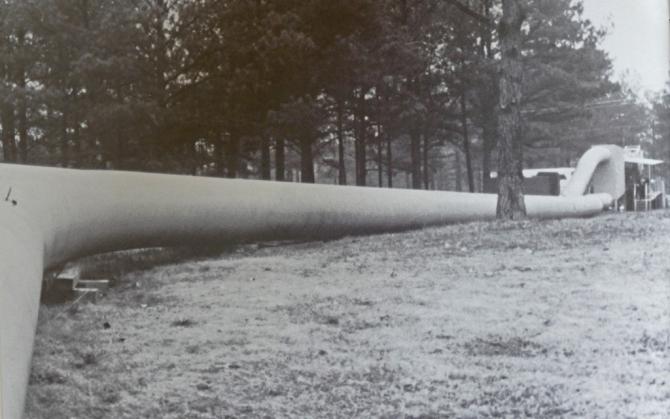
Decades before tech magnate Elon Musk unveiled his idea for the Hyperloop—a high-speed, tubular-shaped transportation system driven by air compressors and linear induction motors—Tech civil engineering professor Marion Robert Carstens devised a similar (albeit stunningly more simple) system with the help of his students back in the late 1960s and early 1970s.
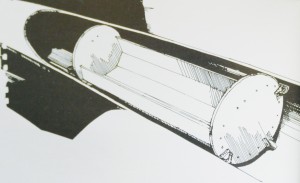 Dubbed the “Tubexpress,” Carstens and future engineers enrolled in his CE-320 Fluid Mechanics lab class worked together to design a pipeline that could transport mail, freight and even human beings. Their goal was to build a system that would be safe for travel and secure from theft, moved independently of automotive traffic and was impervious to weather, accommodated most any kind of cargo, had low power requirements, and required minimal maintenance and operating personnel.
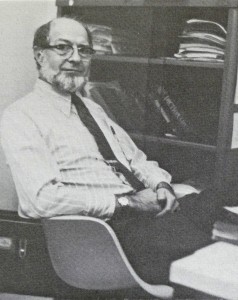
Former Tech Civil Engineering Professor Marion Robert Carstens
Here’s how they envisioned Tubexpress working: A column of air would flow through the tube at atmospheric pressure, and rolling cars fitted to the shape of the pipes would be blown forward. With the help of Homer Bates, the school’s mechanical technician, the team built models of the system in the “cavernous bay” of the civil engineering building. Meanwhile, each class would work on solving different aspects of the project.
The Trans-Southern Pipeline Corp. became interested in the Tubexpress and supported the building of a full-scale, experimental installation on empty land in Stockbridge, Ga. This prototype was designed to move 6-foot-long, cargo-carrying gondolas across a few hundred yards of 36-inch steel pipe that wound over hills and back again along the same route.
With much testing, Carstens and his students got the Tubexpress prototype working quite well. It took only 12 horsepower to get the gondolas traveling at 15 miles an hour, and the system reportedly could move 540 tons of cargo in 24 hours. Carstens personally tested it out a few times by stuffing himself into a gondola armed with nothing but a flashlight and a hammer in case he got stuck.
Carstens and Georgia Tech filed a few U.S. patents on the Tubexpress, but the project didn’t progress much further. Once again, it appears this was another Tech idea that was well ahead of its time.




 Twitter