


 From my earliest days, I can remember being inspired by science fiction—first
visually with old television shows like The Twilight Zone, Lost in Space and Voyage to the Bottom of the Sea. Then I started reading sci-fi and became even more entranced by the genre. The incredible imaginations of Isaac Asimov, Frank Herbert, Robert Heinlein, Arthur C. Clarke and others captured me for years—and still do.
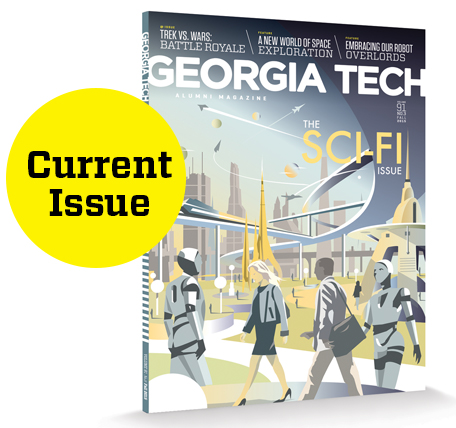
When Star Trek hit television, “Beam me up, Scotty” became part of my personal jargon and the Spock “live long and prosper” hand sign became a parting symbol. When I turned 10, man finally landed on the moon, a feat which inspired many in my generation to want to grow up to become astronauts. Not long after, Star Wars hit the silver screen. I don’t know if there’s been a more powerful pop cultural influence on Gen Xers and Millennials than Star Wars. (Be sure to read the lively Star Wars vs. Star Trek showdown, featuring College of Engineering Dean Gary May.) So when Editor Roger Slavens suggested we devote an issue to science fiction, I was completely on board. We hope you like this issue: sci-fi Georgia Tech style.
This whole field emanates from the imaginations of people and their passion for predicting and shaping the future. Georgia Tech is a sweet spot for people to imagine, create, discover and change the world as we know it. And the history of Tech is filled with just such people.
The Winter 1972 issue of this Alumni Magazine ran an article about a human transport system where a person would get in an air-powered tube and be transported at high speeds to other locations. In 2012, visionary thinker and entrepreneur Elon Musk suggested the Hyperloop—a much more advanced version of this same idea. (Read “Before the Hyperloop” for more details.)
Artificial intelligence is another hot topic of Tech research—our College of Computing ranks sixth nationally in AI thought leadership—that has long been a mainstay of science-fiction conjecture. Now advanced AI is becoming a reality as computational capabilities have exploded. We only need to look back at the past decade or two to see the remarkable, sometimes scary changes that have resulted from our new technological capabilities. Teaching machines to “think and reason” will be transformational. In this issue, we take a deep look at the ethics of AI, and how we can work to make sure humankind won’t ever bow down to its robot overlords.
These are just two of the fascinating future-thinking ideas the Alumni Magazine explores in this issue. As human beings, we’re only constrained by the limits of our imagination. Some of these ideas are hundreds of years old. Take DaVinci’s winged suit, for example, and then look at the flying suits of today’s mountain daredevils. Science fiction truly is a “thought channel” which enables us to think beyond the boundaries, the paradigms and the truths of today.


 Twitter