


It never hurts to throw your hat into the ring. At least, that was Dan Carey’s thinking when he decided to apply to become one of the first humans ever to step foot on Mars—and never again return to Earth.
“The possibility of participating in the human exploration of the solar system is something I just couldn’t walk away from without at least putting in a piece of paper and a video,” Carey says.
Carey, AP 85, thought it was a long shot. He was one of a reported 200,000 people who started an application to the Mars One project. But after making it through the first two elimination rounds, Carey is now one of just 100 people selected as potential colonizers of the red planet by Mars One.
Mars One is a nonprofit organization based in the Netherlands that hopes to launch the first manned mission to Mars in 2026. The organization plans to fund the mission with private investments and revenue generated by broadcasting the mission on TV. It’s backed by some heavy hitters in the space exploration field, including several revered scientists, engineers and even a former chief technologist from NASA. But there are many skeptics who question whether Mars One can make these plans a reality.
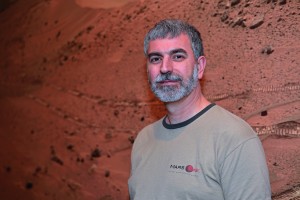 In any case, Carey says he’s inspired by the organization’s unconventional approach to space exploration. And that includes the fact that Carey is not an astronaut—he’s a data architect. He doesn’t have a PhD, and doesn’t have any of the technical training that he would need for a space mission with NASA. But he’s made it this far in the selection process because Mars One is interested in more intangible qualifications.
“They’re not looking so much for a particular skill set. If you have someone who’s reasonably intelligent, you can train them,” Carey says. “But you have to find the right personality to deal with people in a very limited circle. It’s a one-way trip—you’re going to be living with these people forever.”
Carey’s interest in the Mars One mission stems from a life-long love of space. His first library book at age 5 was about the Mercury space program, and the Apollo astronauts who went to the moon were his childhood heroes.
But his candidacy does comes with a price. He’s a husband and father who will have to leave his family forever if he’s selected for the program.
“Prior to Mars One coming along, I couldn’t conceive of something that would make me want to leave my wife and my children and the rest of my family and friends,” Carey says. “But because I do believe a human mission to Mars is important enough and would have a beneficial enough effect, it feels almost like an obligation to go.”
Carey understands there are many critics who can’t understand why he would consider giving up everything for a cramped and isolated existence on a far away planet. There are obvious reasons—to pioneer, to explore, to hunt for signs of life—but also a desire to give people back on Earth a reason to prioritize better stewardship of the planet.
“When people see how stark Mars is—it’s beautiful in its way, but it’s stark—when they see how we have to really work and struggle to survive in the second best place to live in the solar system, that may make them pay a little more attention to Earth and take a little better care of it,”
Carey says.
While he has thought a lot about Mars, Carey’s departure from Earth is far from a done deal. First, he still has to make it through the remaining selection process, which will whittle the Mars One candidates from 100 to 24. A selection committee will observe the remaining candidates as they go through group dynamic challenges and assess how each of them works together. The 40 strongest candidates will then proceed to the next phase, where they will spend nine days in an isolation unit.
“It is very important that the candidates are observed closely to examine how they act in situations of prolonged close contact with one another,” says Dr. Norbert Kraft, Mars One chief medical officer. “During the journey to Mars and upon arrival, they will spend 24 hours a day with each other. It is during this time that the simplest things may start to become bothersome. It takes a specific team dynamic to be able to handle this and it is our job to find those that are best suited for this challenge.”
After the isolation phase, 30 candidates will be chosen for an extended interview to determine their suitability for Mars settlement, after which the final 24 candidates will be offered full-time employment with Mars One.
Carey understands those skeptical of the mission. “There are a ton of challenges to be met,” he says. But he can’t help being optimistic. “Believe in the future. Believe in humanity. This will be one of the great things humankind undertakes.”




 Twitter