


Memories of Naval Barracks
Your excellent January/February issue included a letter from Bruce Smith, EE 51, suggesting more memories about the Naval Air Station campus after World War II. Not only did it accommodate returning war veterans but also 17-year-olds like me because there was no dorm space available on the main campus.
I was a co-op student who came to Tech in the fall of 1946. After being advised that there were no dorm rooms available on campus, my family assisted me in finding a room in a home on Ninth Street near Piedmont Park.
During my winter work quarter, I learned about the NAS campus in Chamblee and signed up for the spring 1947 quarter.
The barracks were divided into cubicles, accommodating two students, with a double bunk and study desks. This presented some noise problems since the cubicle dividers were open at the top. We had a common head (bathroom) for the 80 or 100 on our level. My roommate was a returning veteran, probably five years older than me — nice guy and a good student.
Our classrooms were set up at NAS, but we had to travel to the main campus for labs, physical training and ROTC drill, which was an experience. I don’t recall that anyone had a car. We attempted to pool up when possible into fours and catch a taxicab, which were readily available outside the NAS gate thanks to some enterprising cab company.
We put in 15 cents each for the 50-cent fare and tipped the driver a dime to take us the two or three miles to Oglethorpe University on Peachtree Road. This was the end of the line for the trolley, which we boarded for the trip to North Avenue, where we got off and walked past the Varsity to campus.
Yes, we had a mess hall. As you might expect, some students complained about the food, but it wasn’t all that bad. The veterans said it compared, good or bad, to the food in the Army and Navy.
Techwood Dorm was made available to co-op students for the fall quarter of 1947, so I was able to room there for the rest of my days at Tech.
The quarter I spent at the NAS campus was a good one for me, involving discipline, study and commitment.
I am so thankful for not only the NAS trials we encountered but for all the experiences at Tech that prepared me so well for the future.
Paul Edfeldt, IE 52
Birmingham, Ala.
Celebrating $1.19 an Hour
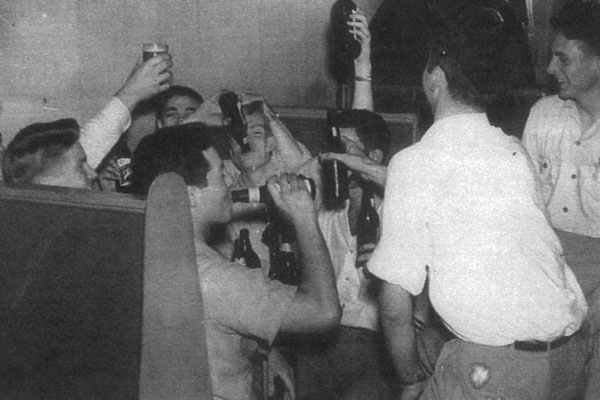
Celebrating job offers from the Bell Bomber Plant in 1943 are Jim Loudermilk, Bill Bransford, George Hausmann, Sy Lampert, Lee Daughtridge, Aleck Bond, Hugh Hunter and Charley Adams.
It’s time to mention something about a bunch of Georgia Tech Wrecks, part of the first grads who completed the accelerated AE option during World War II. Several ended up in the armed forces, while others became important components in the expanding aircraft industry and ultimately the space program.
The photo shows a gang of AE seniors in 1943 who had just returned from interviews at the Bell Bomber Plant in Marietta, Ga. We were celebrating the best offers we had received to date — $1.19 an hour.
Unfortunately, many members of the class of 1943 are no longer on the planet so I have no idea how their careers evolved.
My early work was with NACA Ames Lab. I worked at JPL during the time I was at Caltech. In later years, I was a consultant to the lab on several space projects. I was the director of advanced systems at North American during the development of the Apollo spacecraft.
Today I am a University of Southern California professor emeritus.
Maybe we may hear from some of these elderly Wrecks. They may just be wrecks.
Sy Lampert, AE 43
Irvine, Calif.
Six Degrees of Separation
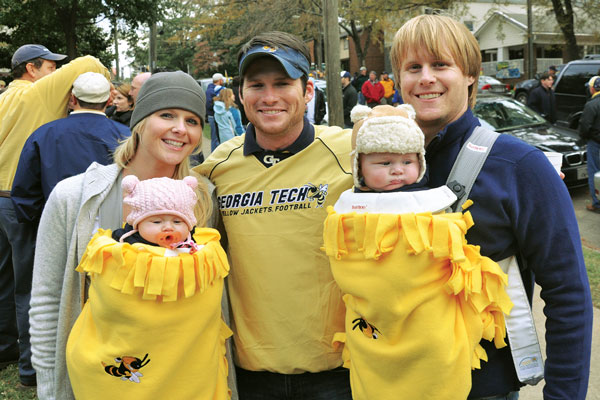
Twins Madison and Wyatt Wynn were escorted to Georgia Tech's Homecoming in October by their parents, Mabry, ME 04, and John Wynn, Mgt 02, and friend Brian Oates, Mgt 02.
Every once in a while I am reminded of how small the world can be and how close six degrees of separation is in reality. One of those moments occurred as I was enjoying reading the stories of how Tech graduates are contributing to the science, art and humanity of practicing OB/GYN medicine [November/December].
During my years at Kennestone Hospital, I enjoyed working with Dr. G.B. Espy on a number of projects and call him friend. In his list of accomplishments, the one I hold dear is his care of my wife and the birth of my daughters Hope and Mabry. As I recall, they were born sometime early in his record 12,000-plus birthing career.
That second healthy baby girl, Mabry, whom he brought into the world right before he left town to run a marathon, went on to be a Ramblin’ Wreck (ME 04), to marry a Tech man, John Wynn (Mgt 02), and last June gave birth to twins Wyatt and Madison (Baby Buzz Club members 2009).
There is definitely a pattern here and enough circumstantial evidence to prove an additional proposition that these doctors have probably contributed in another significant way to improve our world — that is bringing into this world future Georgia Tech students and alumni. Thanks for the great article and the opportunity to bring back to life wonderful memories and images.
Brue Chandler, IE 70
Knoxville, Tenn.
Cost of Education: Priceless
During my years at Tech, from 1945 to ’49, I kept a meticulous record of every penny that I spent. (Believe it or not, I still do.) I ran across my Tech notebook with all these expenditures while I was going through some old files recently and thought it might be interesting to see what has changed.
Here are a few items extracted from my old notebook:
RAT cap — $1
Haircut — 50 cents
Shoes half soled — $1.50
ROTC uniform — $20
Benny Goodman dance — $4
One-month meal ticket — $30
Tennis racket — $2
Golf at Piedmont course — 50 cents
Golf balls — Three for $1
Train home to Daytona Beach — $7.50
Out-of-state semester tuition — $138.50
Total cost of tuition and books for four years — $1,978.50
Total cost of four years at Tech — $6,077.77
I hope that a cup of coffee won’t cost $45 in 60 years, but if history is any indicator, that 5 cent cup at Georgia Tech seemed a lot better than the $1.50 (and up) cups today.
I always enjoy the Georgia Tech Alumni Magazine and an occasional visit by an Alumni Association representative to keep up-to-date on the activities at Tech. Keep up all the good work that you are doing.
Joe Roberson, IE 49
Rancho Mirage, Calif.
Darn Good Game
Iowa beat us in the Orange Bowl, but we played a darn good game. We can be proud of our Jackets.
I’d like to hear from anyone from the Class of 1940 that has made it this far. Personally, I think the Class of ’40 is the greatest group ever to graduate from Tech. Most of them saw all of World War II and have made it through several recessions.
Give me a buzz at [email protected].
John Gaines, ChE 40
Prairie Village, Kan.
Another Water Solution
I read the Solution to Water Woes letter from alumnus Guillermo Alzuru in the January/February issue of the Alumni Magazine. I have similar thoughts to try to rectify some of our water problems.
I wrote the following in a Dec. 19 letter to the Savannah Morning News: “Water continues to be a problem in many parts of our country. We may have flooding in some places and, simultaneously, droughts in others. To reduce this problem, I visualize a system that will have a series of pumping stations to transfer water to and from large basins throughout critical parts of our country. They also could have pipes that would pump excess water into the sea. The overall system would have a central control station that monitors all of the basin levels and constantly monitors for anticipated rainfalls. This could consist of large reversible, variable-speed in-line pumps that transfer water through underground plastic pipes. It would be very costly but may be a good cost- and life-saving project.”
I think the suggestion I sent to the Savannah Morning News is a practical solution that does not have to be accomplished as a single unit but could be placed into operation in various phases. When completed, it would all run as one common system. Maybe the civil engineering department at Tech could undertake a study.
Richard Leech, EE 56
Richmond Hill, Ga.
Whose Logo?
I am afraid there is no true owner who has the proof needed to say he created the GT logo. My husband, Rick Schirm, has for years been telling me his story of doodling the GT logo as it stands today and leaving his notebook with the equipment manager, Buck Andel.
My husband was a tight end who signed with Tech in 1965 and played football as a freshman. He then went off to the Army for five years before returning to Tech to graduate in 1974 in industrial management.
I don’t think the article [The Story Behind GT, January/February] is correct. With Buck no longer with us, there is no proof as to whose notebook was actually submitted.
Debra Schirm
North Palm Beach, Fla.
Respect White and Gold
The article The President’s Residence at 60 mentions several times that President Peterson’s wife Val is aware that Georgia Tech’s school colors are old gold and white and that any future redecorating she does in the residence will “respect the school colors.”
I wish that whoever it is that authorizes the licensing of Georgia Tech retail apparel would follow Mrs. Peterson’s example. In any retail store selling college-themed apparel, including the Barnes & Noble “official” Georgia Tech bookstore at Spring and Fifth streets, just try to find any substantial selection of Georgia Tech apparel in old gold and white. You might as well be in the Naval Academy or Auburn bookstores. The athletic department gets it: All the sports teams are decked out in old gold and white, at least most of the time.
Yes, I know that navy blue is supposedly an official school color also, but why is navy the dominant color in Georgia Tech apparel? Why not “respect the school colors,” as does Mrs. Peterson, and provide us with some white and gold stuff to wear?
Daniel D. Hull, CE 62
Roswell, Ga.
James H. Tipton, whom I remember as Jimmy Tipton, sent a letter for the January/ February issue about professor Ed Folk that brought me a poignant memory.
My family, that of professor Glenn Rainey, who taught in the English department with Professor Folk, lived in the faculty apartment next to the Folks on Techwood Drive. I believe the dorms were Smith and Harris. Professor Folk’s daughter, Allison, was my first girlfriend and the first girl I ever kissed.
That kiss occurred at a Tech football game in the old west stands of Grant Field along about 1943 when Allison and I were about 7 years old. It was my first football game, and I was awed by the spectacle. At one point when the crowd erupted, I asked Allison what had happened. She told me that Tech had scored a touchdown and that we were ahead.
I was so elated I grabbed Allison and kissed her — to the great delight of the adults, to her great embarrassment and to my indignation that the adults made light of such a serious matter.
I don’t know how the game came out, but I do remember the kiss.
Ed Rainey, CerE 60
Hilton Head, S.C.



 Twitter