


Feline friends corral campus cats
kelvin kuo ↑
A mischievous calico roams the grounds of north campus. If there was a Most Wanted list for the cats that live at Georgia Tech, she would top it. Over the years, she has given birth to dozens of litters. While most of those kittens have found homes off campus thanks to the tireless after-school efforts of some Tech faculty and staff members, like an outlaw, this feline, aka Mama Calico, eludes them.
“It’s been six years,” Steven Johnson said, “and I still haven’t been able to catch her.”
Of the roughly 50 abandoned or feral cats that wander about campus, Mama Calico is one of only a handful that have not yet been caught and spayed or neutered by Johnson or his cohort in campus cat trapping, Josie Giles.
These two are no rookies when it comes to catching cats. Combined, they have captured more than 1,000 felines on and off campus.
In addition to his full-time job as Auxiliary Services’ project manager, Johnson serves as Georgia Tech’s go-to guy for all things cat, an unofficial post for which he is not compensated. If a litter of kittens or an injured cat is spotted on campus or if a cat falls through the ceiling of an office — it has happened — he gets a call.
By day, Giles is an information specialist for the School of Chemical & Biomolecular Engineering. But as night falls, this longtime cat rescuer and tamer is scanning the grounds of the north end of campus and the parking lots and alleyways of metro Atlanta in search of homeless felines.
With help from other members of the Tech community, including professors, librarians, maintenance workers and deans, Giles and Johnson work to keep the campus cat population in check.
Kittens and tame abandoned cats are caught and cared for by foster parents, often Tech faculty or staff, until permanent homes are found for them. Adult feral cats are trapped, spayed or neutered, vaccinated for rabies and returned to campus, where they live out the rest of their lives. Giles, Johnson and three other Tech employees act as caregivers for these cats, keeping an eye on their health and providing them with dry food and fresh water at seven discreet feeding stations.
Even though many people at the Institute know of its existence, this under-the-radar, volunteer-based cat management program receives no campus funding. Caregivers buy the food and until recently paid for all veterinary visits. Johnson said Fulton County Animal Services now covers the cost of spaying and neutering the animals because it recognizes Georgia Tech as having a managed cat colony.
With its lush landscaping and endless nooks and crannies, the Georgia Tech campus provides a perfect respite for homeless felines seeking some peace and quiet from the hustle of the Atlanta streets. Most of the cats are feral, that is the wild offspring of abandoned cats, and are frightened by humans. They sunbathe in the secluded grassy knolls around the Architecture Building and seek shelter in the storm drains of the library or crawlspace of Tech Tower.
“The cats are here because the environment supports them, not because we feed them,” Johnson said. “All our feeding stations do is bring the cats together so we can monitor them.”
Trapper Johnson
Librarian Jeff Carrico watches over the cats living near the library’s loading dock. He tops off bowls with food and fresh water each day at the library feeding station and on three-day weekends drives to campus from his home in Douglasville to feed the cats.
One afternoon in March, he spotted an unfamiliar gray tabby nibbling on the food. The cat was frail and had trouble walking and eating. Concerned, Carrico e-mailed Johnson and gave him a description of the cat. Johnson told Carrico not to worry, that he’d be on the lookout for the tabby.
The following day, Johnson stepped out of the Student Center into the afternoon sun, walked to the parking lot and pulled a metal cage from the bed of his pickup truck. Kneeling on the sidewalk, he emptied a can of wet cat food onto a paper plate. He dropped a spoonful of the food just inside the cage door and put the plate near the back. He crossed the lawn and placed the cage near a bench, under which the gray tabby lay nestled in the shade.
Johnson stepped back several feet. The trap was set. Now all he had to do was wait. He stood with arms crossed and eyes set on the cat, waiting for the aroma of a Fancy Feast dinner to tempt him into the cage.
The enticement worked. In less than a minute the cat had finished the few morsels at the front, made his way to the back and stepped over the trip lever that dropped the cage door.
“We’ve got a trapped cat,” Johnson said.
Johnson placed a blanket over the cage and returned it to the bed of his truck. “We put the cover over it in order to calm him down, and he’s going to go back to eating that food. He’s been having trouble eating. … That gives us an idea it might be one of his teeth.
“That’s pretty much it for trapping a cat,” Johnson said. “That’s one of the easier ones.”
For catching kittens, which tend to work themselves into the hardest-to-reach places, Johnson has a long pole affixed with a net. And for trapping the more wily feral cats or the occasional raccoon, fox or opossum that shows up at a feeding station, Johnson arms himself with a pair of coveralls, gloves, boots and a hat. He’s already guarded against rabies. (He has trapped so many feral cats over the years that his veterinarian insisted he receive the pre-rabies exposure vaccine.)
Trapping usually takes place at night, when cats are most active. Johnson recalled one Friday night expedition to trap a litter of kittens living in containers on the Student Center loading dock. To his surprise, the mother cat darted into the cage within a few minutes. But it took him until 4:30 in the morning to get the last kitten into the cage.
“I’m sitting on the loading dock, and … before I know it, I’ve got two police cars with the blue lights flashing pulling up because the Dining Services security camera saw somebody hanging around the loading dock,” he said.
Luckily for Johnson, officers in the second cruiser knew him.
“That’s one of the things we’ve learned, to call the desk sergeant so they can tell the shift that, ‘Oh, by the way, over by the stadium or up by the president’s house, you’ve got crazy people with cages that are draped that look like bombs who are going to be hiding in the bushes,’” Johnson said. “It’s a matter of getting to know people and getting the word out.”
There’s probably a lot more trapping to be done in the coming months.
Johnson said college campuses are the No. 3 spot for dumping unwanted cats, right after veterinary offices and animal shelters. Students often abandon cats when their parents won’t allow them to bring home the pets they’ve been keeping. And Johnson thinks people outside of campus probably dump off unwanted cats because they consider college students to be kind-hearted souls who will feed the cats.
The cat program volunteers have found countless kittens dropped off near trash containers or at the recycling center after move-out time.
Johnson has one of those cats at home. Scamper was just 4 weeks old when he was fished out of a garbage bin by a maintenance man after students left campus one year for summer break.
Scamper, now 12 years old, was Johnson’s first Tech cat. Of the seven cats he has at home, five are from campus.
“I did not intend on having that many, but I also socialize the kittens. Through the course of that, there’s always that one in the litter that’s a little special … so out of the four kittens you socialize, only three go up for adoption. That’s one of the hazards of this.”
In the Beginning
Johnson first became aware that Georgia Tech had a cat problem back in 1997. He was working in the housing department at the time and receiving a number of calls from students who had spotted kittens and injured cats near dorms. After countless visits to animal control and the Atlanta Humane Society to drop off cats, Johnson and a co-worker in Facilities, Susan Wardrope, realized they needed to go after the root of the problem — the mating queens and tomcats. They learned about the trap-neuter-return method of feral cat management through the Web site for the Alley Cat Allies advocacy group.
Socializing a feral cat sometimes can be done but requires dedication and patience. When taken to shelters, even no-kill adoption centers, these cats often are euthanized because they cannot be placed in homes.
According to the LifeLine Animal Project, an advocate of trap-neuter-return programs that provides low-cost spay and neuter services through its clinic in Avondale Estates, animal control spends an average of $110 for every feral cat it traps, impounds and euthanizes.
Supporters of the trap-neuter-return philosophy also argue that removing feral cats from an area only exacerbates the problem; new cats will move into the area, and those left in the colony will continue to breed.
The Humane Society of the United States now is an advocate of community-based trap-neuter-return programs, calling them “the most viable, long-term approach available at this time to reduce feral cat populations.”
Johnson and Wardrope began wrangling cats on the east side of campus, where a colony of 19 cats was producing about five litters of kittens each year. They soon expanded their operations to the west side of campus, which had a colony of eight cats.
Johnson recalled in the early days of the program once having five pregnant cats in cages at his home. “They all gave birth the same night. I immediately went from five cats to five cats plus 19 kittens.”
In 2000, Johnson placed an ad in the faculty/staff newspaper inviting all those interested in the welfare of the campus cats to a meeting at the Student Center. Only six or seven staff members and professors showed up, but Johnson realized he and Wardrope were not alone and that Tech’s cat problem was much worse than he originally had thought.
Shortly thereafter, they conducted a survey and discovered Tech had 179 cats.
Though Wardrope since has moved on from Tech, Johnson has been practicing the trap-neuter-return basics for nearly 14 years. During that time, the cat population has been reduced to between 44 and 48 cats.
Several feral cats in the program have lived happily on the Georgia Tech campus for years. Marmalade, an orange and white cat, has dwelled in the drainage system by the Student Center for about six years. And then there was Marmalade’s companion, a gray tabby named Melanie that died just last year. She was thought to be 16 years old, the oldest campus cat.
Johnson recalled luring Melanie into a trap after her litter of five kittens went into it. The kittens were adopted, and Melanie was returned to campus after being spayed.
Eventually Melanie could identify her caregiver’s car when he pulled into the parking lot. The campus volunteers took Melanie to the vet as she developed health issues and began giving her antibiotics in her final days.
“When it came time for us to pick her up and take her in, she came to us,” Johnson said. “She actually died in my lap at home. At least she knew who was caring for her.”
A Home for Burdell
Giles’ office is littered with cat stuff. There are photos of her cats — she has five and fosters several more, many of them from Georgia Tech — and there is a Crazy Cat Lady action figure. The knickknacks sometimes serve as conversation starters with the engineering students she meets working in communications for the School of Chemical & Biomolecular Engineering, giving her the opportunity to educate more students about the campus cat program and the importance of being responsible pet owners.
Giles goes through about 10 bags of cat food each week. That’s not just for the cats she cares for at her two feeding stations on the north end of campus but for the dozens of other cats she monitors around metro Atlanta.
She began working with her first cat rescue group in 1998 and for 10 years volunteered after work and on weekends as an adoption counselor at PetSmart. Giles said she developed a reputation of being able to tame adult feral cats and often was sent the wild ones.
“A lot of people have jokingly called me a cat whisperer. Some ‘listen,’ others don’t, of course,” Giles said. “Sometimes if you tame them when they’re too old, they’ll be a baby with you, but with anyone else they’re under the bed.”
Although Giles has worked at Tech since 2000, it wasn’t until her department moved to the Ford Environmental Science & Technology Building in 2003 that she became aware of the number of cats on campus. She remembered leaving the office late one afternoon and seeing five cats perched on a wall.
Giles now cares for cats living in the president’s glade and the recycling center. Her feeding stations are two of the most trafficked because of their proximity to 10th Street and Home Park. She hopes to soon be able to make a bigger commitment to the campus cats.
After years of work, Giles and business partner Kathy Thornton opened a no-kill, cage-free cat adoption center at the end of April. The nonprofit Krazy About Kats Foundation (krazyaboutkats.com), located in Gwinnett County, will serve as a halfway house for many of the kittens found on the Georgia Tech campus.
Kittens that are under 8 weeks old, considered young enough to be socialized, are taken to local no-kill animal shelters when space is available. But space is rarely available.
While Krazy About Kats is not strictly for Georgia Tech cats, Giles and Johnson hope it will have a strong relationship with the campus community. In many ways, it has been a Georgia Tech effort, said Giles, who recruited friends from the Institute to do the electrical and HVAC work and sanding and painting for the facility.
“This is something I’ve wanted to do my whole life, to actually have a place,” Giles said. “Kathy and I knew each other through our rescue work for many years. She founded the nonprofit, and I joined her in the effort to establish a physical adoption center.”
Krazy About Kats will celebrate its grand opening this summer with a fundraising event. The facility already has several tenants, including Burdell and his sister, Georgia, that have been fostered by Giles. The cats were left by Mama Calico about a year ago near the Klaus building.
Friends and Foes
After trapping the gray tabby, Johnson toured the campus feeding stations. Caregivers avoid setting them up near building entrances and places where people congregate. Instead they are hidden away in less-traveled spots, often camouflaged by trees and shrubbery.
Johnson’s eyes scanned bushes, ditches and storm drains in search of cats not in the program. They’re easy enough to identify. Once spayed or neutered and vaccinated, the cats are ear-tipped to let animal control and caregivers know they’ve already been fixed.
Johnson paused when he came to a quiet clearing on the east end of the Skiles building in which a couple of students sat on benches poring over books and eating lunch.
“This is one of the places we have to go when we police because we have to make sure no one’s put out food for them. This is not a feeding station for the cats. We don’t want them drawn here because we don’t want complaints,” he said.
When Johnson or Giles find that someone has been leaving out leftover food for the cats, they either will track that person down or leave a note to let him know someone is looking after the cats and feeding them nutritional food. It is not just the students who leave out food. Construction workers also have soft spots for kittens and are known to leave out chicken wings, a big no-no.
“Don’t bring out chicken, don’t bring food out of the dining facilities to feed the cats,” Johnson warned. “Number one, it looks messy on campus, and that’s one of the things we try to maintain is a clean feeding station so it doesn’t become an eyesore. Because if it becomes an eyesore, all it takes is a vice president or someone to snap his fingers and say, ‘Go away.’”
The campus cat program has its friends and its foes.
There are about 30 or so cat lovers on campus who are kept up-to-date on the cats via e-mail and who serve as back-up feeders when caregivers are on vacation. Then there are the critics who have tried to shut down the program. Perhaps the most outspoken are a few members of the American Bird Conservancy who work at Tech.
“The American Bird Conservancy … basically will not understand that cats are not killing every songbird they see,” Johnson said. “Cats, they mainly go after rodents. That’s their primary prey.”
Johnson said in all of his years caring for the campus cats, he has seen only one cat catch a bird. Instead, the “presents” the felines leave their caregivers often are squirrels, chipmunks and rats.
“They’re doing exactly what they’re supposed to do. They’re predators that have found a niche in this environment. And when you look at the natural balance of it, if you remove one of the predators, you’ll have an explosion of the prey animals,” said Johnson, who claims that the campus cats consistently outperform Tech’s pest control company.
Johnson said Tech’s program has become a model for cat management initiatives nationwide. His expertise in the trapping trade has led Atlanta animal shelters to recruit him to help out with cat issues across town and to speak to groups interested in starting community-based management programs of their own.
He’s even spoken to groups at area colleges and universities, including Oglethorpe, Georgia State and the University of Georgia, which has a nonprofit organization dedicated to caring for and prohibiting the growth of the feral cat colony on its campus as well as a sister organization run by students.
Although Johnson, Giles and company may not have their work sanctioned by the Institute, a new student organization does. Just this past fall, the Animal Welfare Association (awa-gt.blogspot.com) was chartered on campus.
“With hundreds of thousands of animals being euthanized in metro Atlanta alone simply due to lack of homes, we felt that it was our duty as students to do what we could for the animals on our campus and in our community,” said club founder Mary Piantadosi, an international affairs major who has volunteered with the Atlanta and Georgia humane societies.
Now more than 50 members strong, the club already has helped out the campus cat program volunteers. In October, the students rescued three feral kittens, which they domesticated. Two already have found permanent homes with help from the Georgia Humane Society.
A Last Refuge
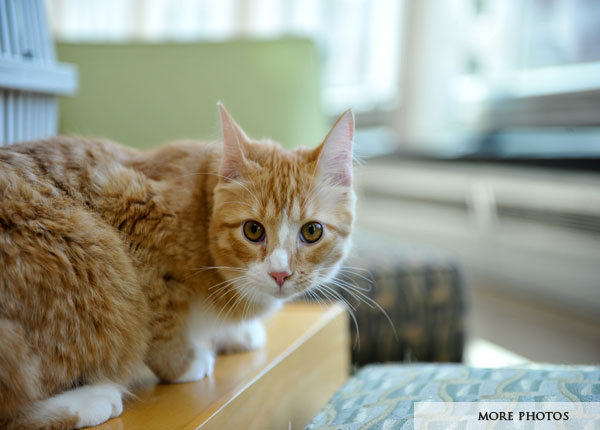
George P. Burdell, the orange and white feline, recently returned to his “alma mater” for a photo shoot. He was accompanied by Trasher, a deaf, blue-eyed, white polydactyl, or six-toed Hemingway cat, found near the Tech recycling center, who was adopted by Giles.
Several students and professors passing through the atrium of the Ford building stopped by to pet the cats before heading out the door.
Unfortunately, not all of the cats found on the Tech campus have such happy endings. Later that same day, the gray tabby that Johnson had trapped just hours before was found to have a number of terminal health issues during a visit to the vet.
In an e-mail to the other cat program volunteers a couple of days later, Giles said she had decided the most humane thing to do was to “end his misery.” She hoped they all agreed with her decision.
In response, Johnson wrote, “It’s not the first cat on campus that we were able to be their last refuge and send them safely on their way in peace.” He invited caregivers to contribute to the cost of cremating the cat, which he had named Aero for the database he keeps.
Though Aero’s stay on campus was short-lived, he befriended several Tech employees nonetheless. In response to the news, Carrico recounted a visit he’d had with the cat just days before at the library’s feeding station.
“After he ate, which he had a hard time doing, I sat under the tree with him as we had before, and we talked for a while,” Carrico wrote. “He always was a good listener and seemed to enjoy the companionship. … I guess I was the last person who was able to hang out with Aero. He really was a sweetheart, and I’ll miss having him stop by to visit and hang out under the tree.
“Thank you all for helping these animals. I hate to think what their lives might be like if it wasn’t for all of your interventions.”




 Twitter