


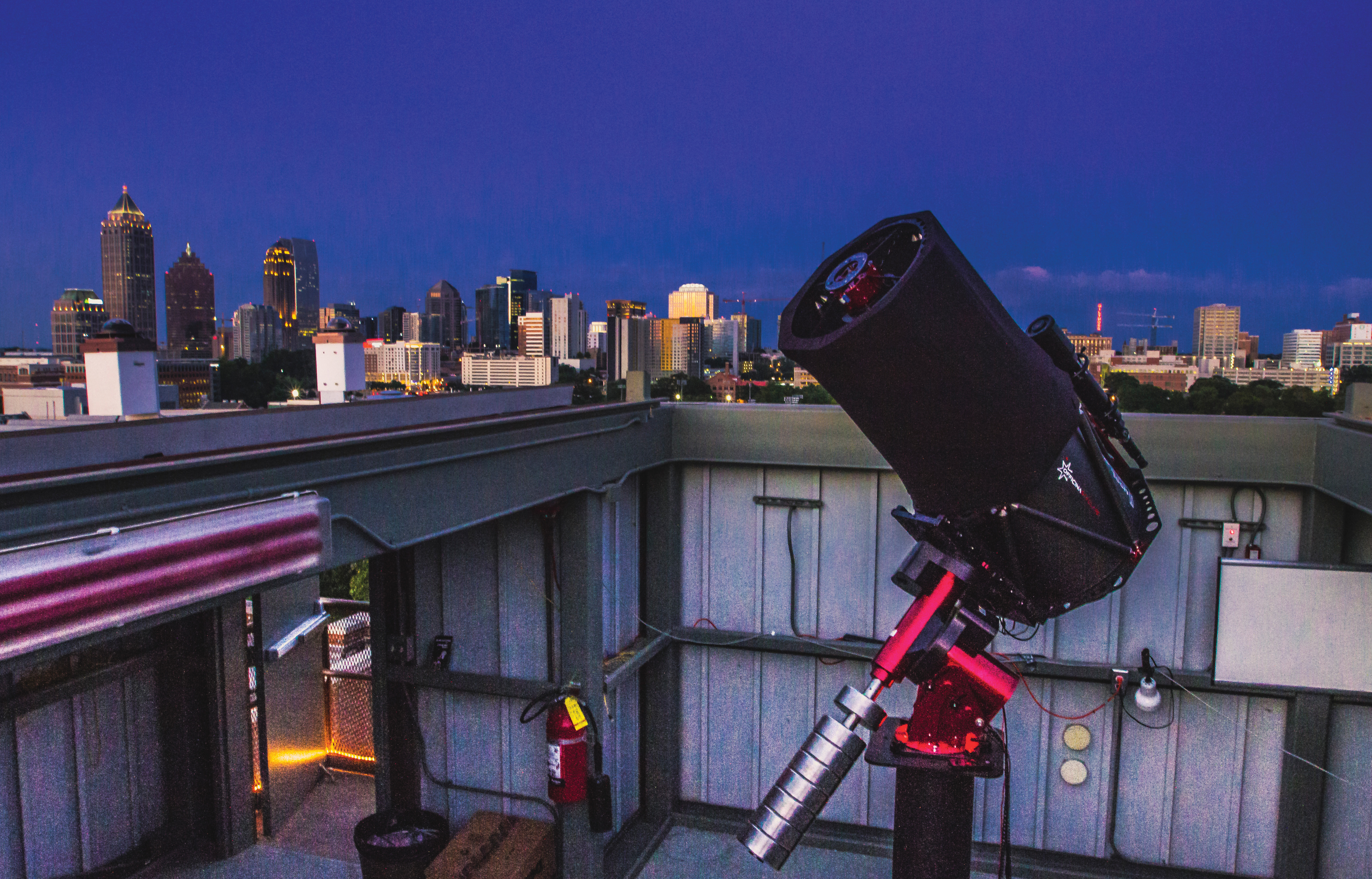
Perched relatively high atop the Howey Physics Building on the southwest side of campus resides something that would surprise most Tech students and alumni. After all, instead of a telltale dome aimed skyward, there’s just a nondescript, rectangular structure that looks like it could be a storage area or perhaps a small classroom.
But when you slide the roof back, you come face-to-face with one of the first Raven-class telescopes ever installed at a U.S. academic institution. The 20-inch Space Object Research Telescope (GT-SORT), valued at $110,000 and weighing well over a ton, is the centerpiece of the Georgia Tech Observatory. Purchased and installed in the summer of 2014 by Marcus Holzinger, assistant professor for the School of Aerospace Engineering—and shared with the School of Physics—this high-powered, world-class telescope gives faculty, staff and students a precise, automated instrument for viewing low Earth-orbiting satellites, as well as the moon and bright planets.
The observatory itself is the brainchild of physics faculty member Jim Sowell, who began teaching astronomy at Tech in 1992. “I had started working a few years earlier at the Georgia Tech Research Institute (GTRI), but my heart belonged to astronomy,” Sowell says. “I finally convinced the chair that the school needed a real astronomer to teach the subject.”
At first, Sowell split time with his work at GTRI, teaching a few intro to astronomy classes. But in 1999 he moved to the School of Physics full time. Sowell’s persuasive ways and tenacity over the years helped lead to not only the creation of the observatory, which opened in 2007, but also a more robust astronomy program at Tech at both the undergraduate and graduate levels. Furthering this commitment, the School of Physics now offers robust tracks in astrophysics for all students, with research being conducted on everything from black holes to gravitational waves.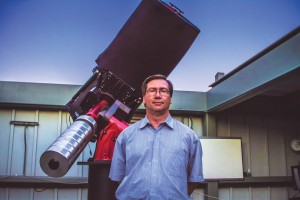
While the observatory—which is open to the public for monthly viewing sessions—still remains mostly a hidden jewel on campus, it’s just one part of Tech’s growing astronomical facilities. Thousands of miles away in Maui, at the U.S. Air Force Research Laboratory, Tech owns and runs the Aloha Explorer, an 11-inch telescope dedicated for a very particular, educational purpose.
“I wanted to be able to bring night-time celestial objects into daytime classes for K-12 students,” Sowell says. “Hawaii offered excellent viewing conditions, as well as the necessary difference in time zones so that children in Atlanta and elsewhere could view the night sky during regular school hours.”
This fall during the first round of field testing, teachers at participating schools—including some Atlanta Public Schools—can sign up for time with the Aloha Explorer telescope at aloha.gatech.edu. By using a sophisticated video camera system and a secure web-based network, their students can control the telescope remotely to view the heavens.
“I’m not trying to make 100 new astronomers,” Sowell says. “I’m trying to spark excitement. My hope is that someday soon a second grader will be so excited to operate the telescope and investigate the stars that she’ll be inspired to go on to become an engineer or scientist and do it for a career.”


 Twitter